
29 August 26
Two Barcelona Favorites
 I found Barcelona overwhelming, which is probably related to the fact I haven’t lived in a place with more than 190,000 people for over 36 years, but we did visit some interesting spots. My two favorites were the Catalan bookstore and the orxateria.
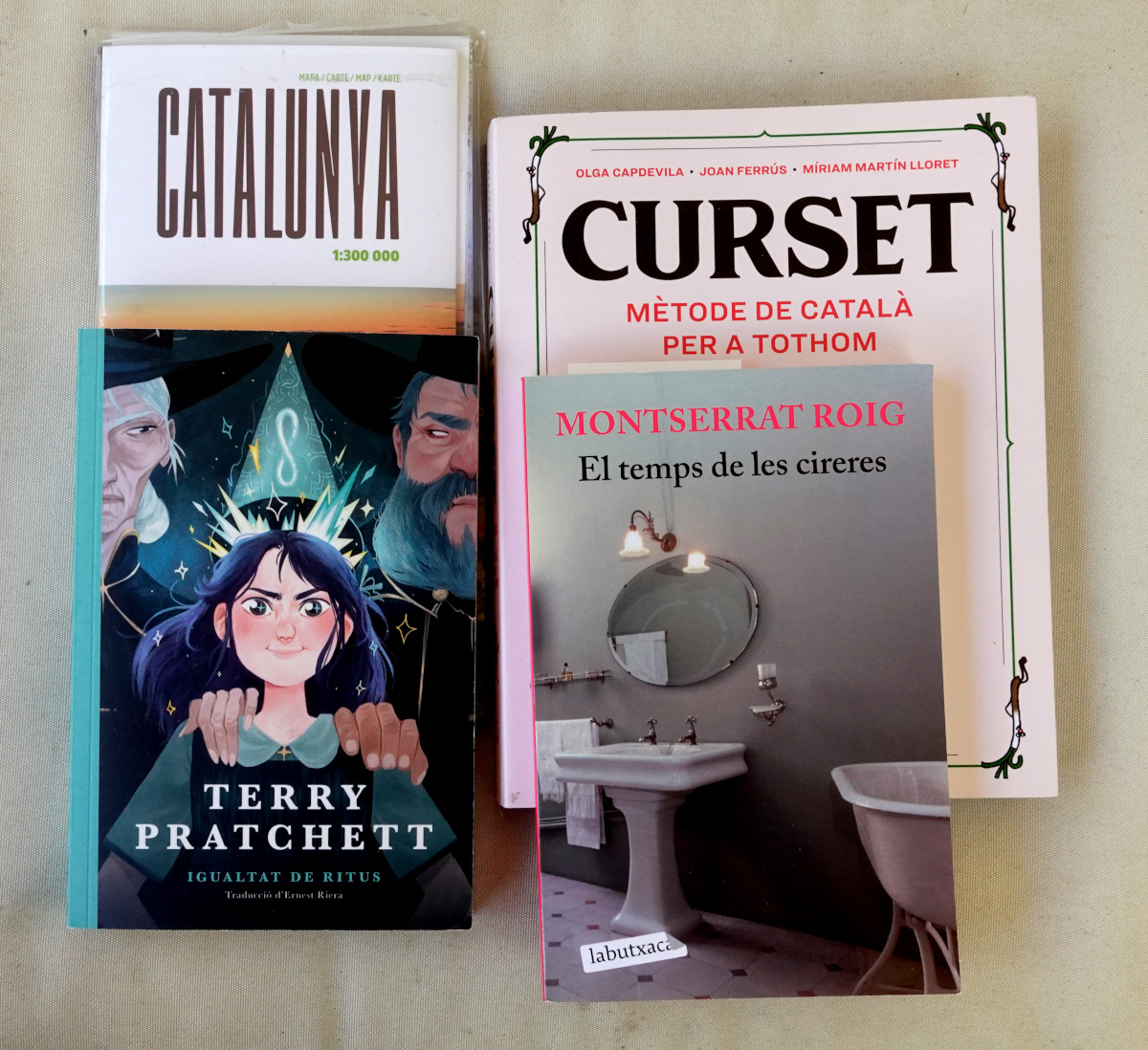
We went to Ona Llibres the evening of Friday August 14th. This is probably the largest Catalan-only bookstore extant. Pica fearlessly conversed with the shopkeeper in the Catalan that she’s picked up and we came away with four publications shown at left from the store: a novel by Barcelona author Montserrat Roig, a Catalan textbook, a translation of Terry Pratchett’s Equal Rites into Catalan (there have been about a half-dozen Pratchett books translated into Catalan), and a 1:300,000 scale map of Catalunya.
The second place was the orxateria. An orxata is a sweet chilled beverage from Valencia and Catalunya that is etymologically related to the horchata from Mexico, but they are made from different bases. The latter is made from rice, cinnamon, and sugar, but the former is made from ground tiger nuts. Bottled orxatas are widely available across Catalunya but I wanted to try an orxata that was made from scratch. Prior to our trip, I had watched a video on the YouTube channel betevé that was entitled Orxateria Verdú, el secret de l’orxata artesana a Barcelona so I tracked the place down. The drink was well worth savoring..
18 August 26
A Trip to Catalunya
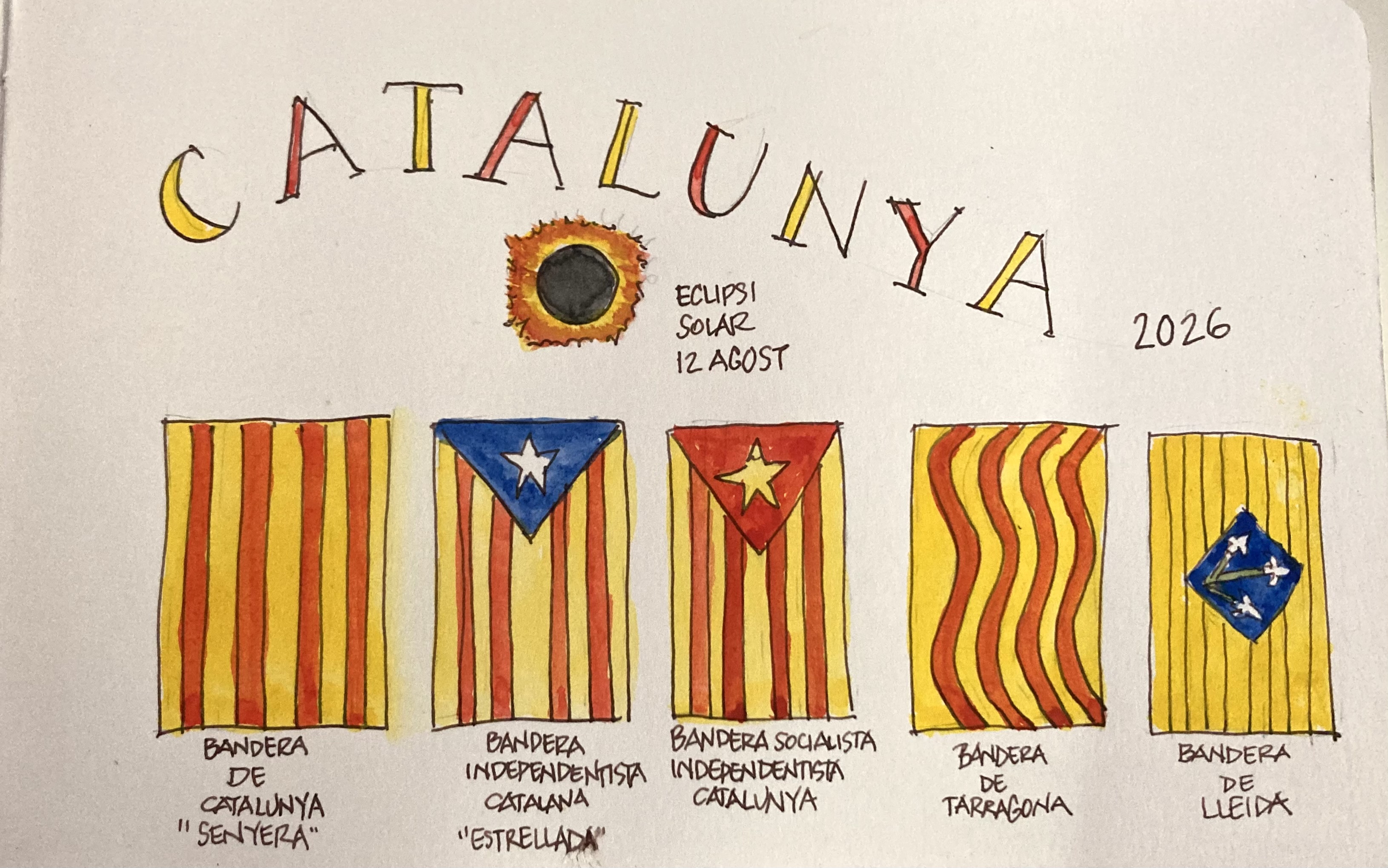
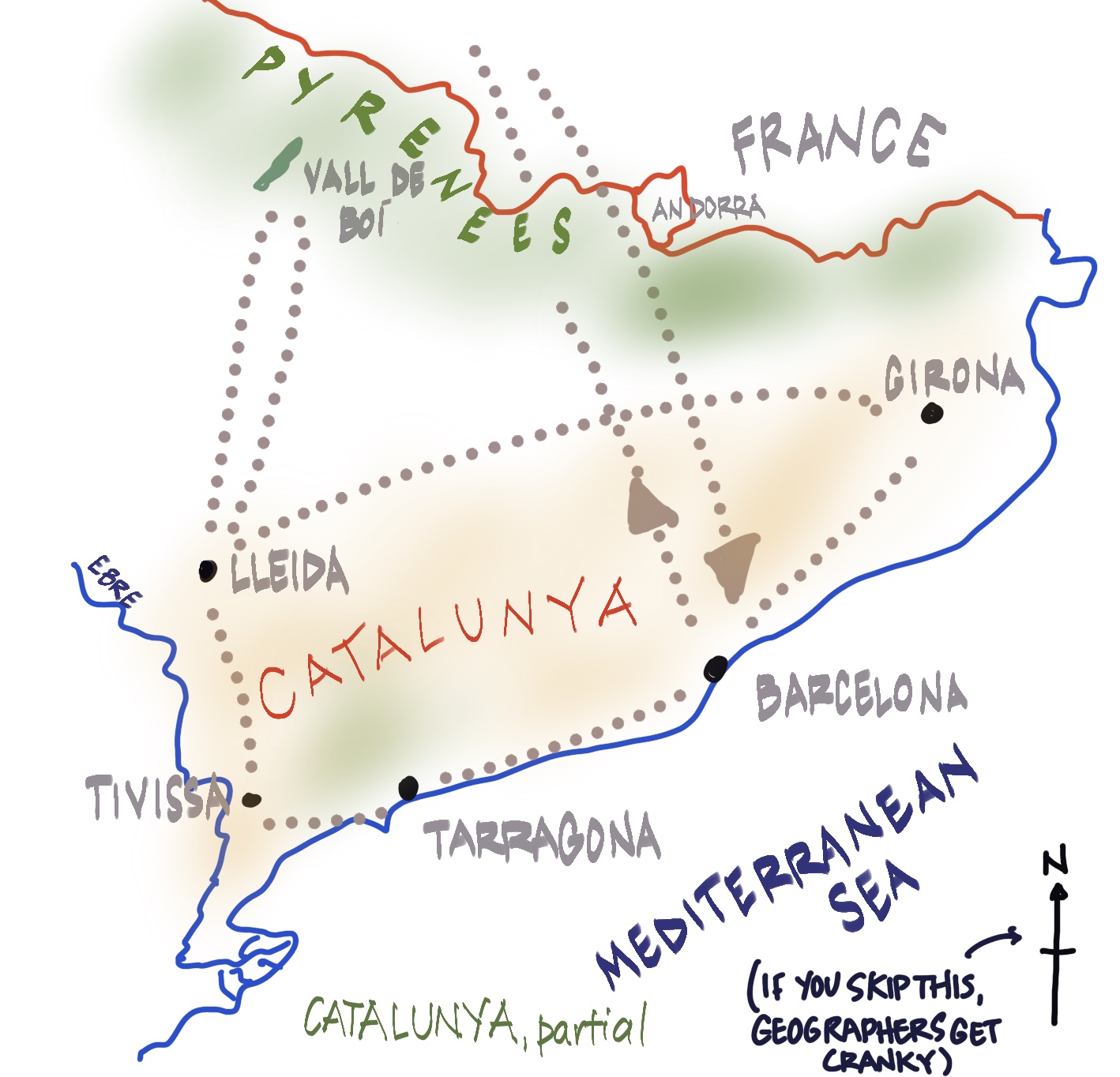 We returned late last night from a trip to Catalunya, an autonomous region in northeast Spain. We flew in and out of Barcelona, went north to Girona where we saw some friends and met up with an avid Urban Sketching group, met up with childhood friends in Lleida where we stayed in a converted convent and from where we ventured into the Vall de Boí in the Pyrenees, went south to Tivissa where we saw some Catalonian friends from Davis and the solar eclipse, rounding out our trip with Tarragona (capital of Roman Spain, Hispania) and finally three nights in Barcelona.
We are tired and a bit out of sorts with the nine hour time difference but we’ll be posting quite a bit about this trip over the next few days. I will say at the outset that I’m glad I’ve been studying my Catalan: I found I was able to hold quite fluid conversations in Catalan! This is much easier because most Catalans speak fluent Castilian but once again I was met with pleasant surprise that I’d made the effort. We visited a Catalan language bookstore in Barcelona and I picked up a novel, a fun and well-illustrated Catalan coursebook, and Numenius picked up a copy of Pratchett’s Equal Rites in Catalan. We were busy. I got blisters.
20 July 26
Rhoticity
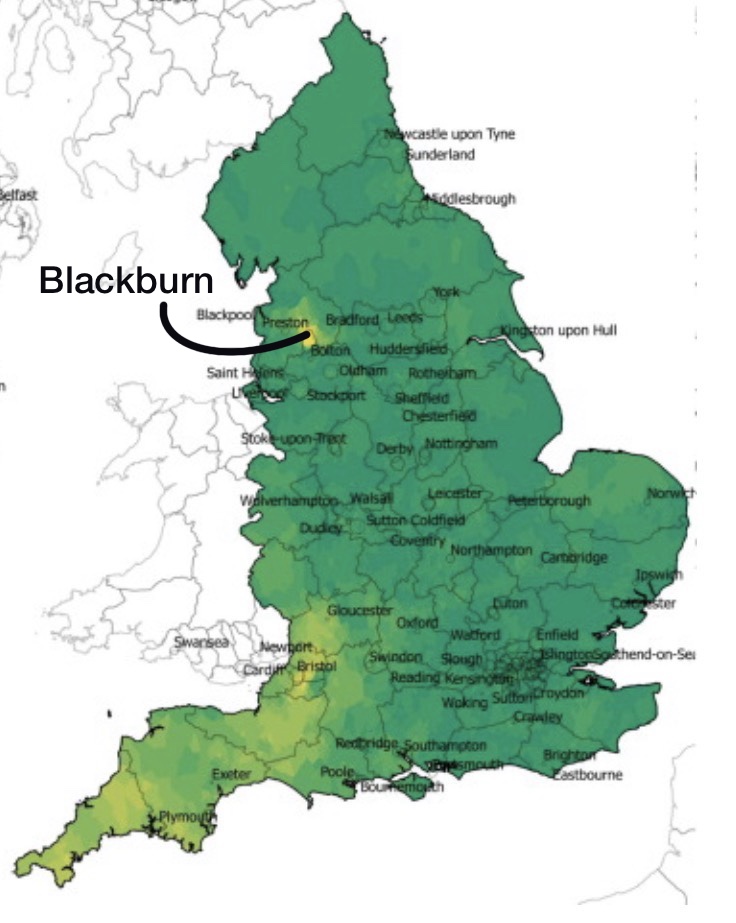 As someone fascinated by language, I find my YouTube feed often contains sometimes quite arcane posts on linguistics. Dr. Geoff Lindsay is a linguist originally from Manchester. I just came across this piece on rhoticity (the pronunciation of the letter “r” in places other than before a vowel) in the northwest of England. There is a small slot that runs from Blackburn and Darwen (east of Preston) down to about Clitheroe, where “r” is (or was; this is a disappearing linguistic feature) pronounced in words like “park” (where most of England, including Lancashire, pronounces this word as “pahk” or even “pohk”). This small pocket is shown on the map at right. It’s worth noting that 60 years ago, a lot of the region and much of the West Country would have shown up as bright red, not yellow as it is now and shrinking.
Rhoticity in England is devalued, made fun of by us schoolkids who said “ooh arr ooh arr” in the 70s to mock a Somerset or Cornwall accent, slow country bumpkin Worzel-Gummidge types. But rhoticity in Blackburn is given high prestige in the community (according to the linguist interviewed by Lindsay); it’s fascinating.
My father was from Blackburn, but moved away to attend university in Leeds (still in the north but in Yorkshire on the other side of the Pennines), then to London as a management trainee and finally to California via the Antipodes. Growing up, I always imagined his rhoticity to be an American contamination, but it turns out it wasn’t. He did incorporate some American expressions into his speech which you’d expect, but “that’s a right load of tripe” and “I wouldn’t give a tin of beans for it” held on throughout his life.
I must have been eight or so when he said — discussing the first world war and his disgust with incompetent military personnel — that “Earl Haig was a butcher.” Rhotic “r” in Earl and butcher; the “but” in “butcher” pronounced like “but” the conjunction.
18 June 26
Shadow Learning
For over three years now I’ve been volunteering to coach an Iranian woman with her English through International House Davis. We have established a deep connection in our weekly sessions. (I have a deep love and respect for Iranian culture and was saddened to hear of Marjane Satrapi’s recent death not to mention the horrific violence inflicted on the country by the U.S.)
I have no ESL training and mostly my Iranian friend and I chat about whatever is going on, which sadly includes politics. But I recently learned about a technique for helping students improve their pronunciation called Shadowing. It goes like this: I read a paragraph in English, then I read the first sentence of the paragraph, which the student then repeats. When we get to the end of the paragraph, she re-reads the whole paragraph.
We are working our way through Seedfolks by Paul Fleischman, a children’s novella about the immigrant experience in a depressed midwest inner-city area where people of different cultures are brought together to transform a vacant lot into a garden. Each chapter is written from a different point of view, and they are short enough that we can cover the chapter in the hour or so.
What is especially useful for language learners is that consistent trip-ups become very obvious with this method. English pronunciation of “th”, voiced and unvoiced(/θ/ and /ð/); /w/; and initial s+consonant are all difficult for speakers of Farsi (and Spanish, of course). More subtle are the vowels. I never actually thought about it but I pronounce the “e” in “the” differently whether it precedes a vowel or a consonant, and have been able to detect these minor hiccups and convey them to my friend. Of course my own pronunciation is different from that of native English speakers who have spent all their lives in the United States, so my “little” pronounces the “t’s” as “t’s,” not “d’s.” I hope my friend can live with that. She is delighted with this method, nonetheless, and we are making good progress.
9 June 26
El Papa Llega
I am not Christian, let alone Catholic, but I have been entranced by the visit of Pope Leo XIV to Spain. He has a lot of fans in the United States: the first American pope has not been afraid to take on American authoritarianism. The spectacle of his tour in Madrid and now Barcelona has been affirming somehow, what with 1.2 million people present for the Mass he led in the Plaza de Cibeles on Sunday. I’ve watched a couple of his speeches in Spanish and the bit that he read today in Catalan.
Tomorrow is I think the centerpiece of his trip to Spain — he will go to the Sagrada Familia where he will inaugurate the Tower of Jesus Christ on the 100th anniversary of the death of the architect of the cathedral, Antonio Gaudí. This centenary would have a big deal in Barcelona even without the visit of the Pope, but he clearly was happy to time his visit to Spain to be present for it.
Prior to the event at the Sagrada Familia, he is heading up to the monastery at Montserrat. Visiting both sites in one day seems like too much to take in, but he won’t have to stand in line to enter. If I were him, I’d ask to see the Llibre Vermell.
8 June 26
Lieblingsautoren
I’ve been a member of an advanced German conversation group for several years, run through International House Davis. A year or so into it our leader got ill and was no longer able to run the group, which had been meeting on zoom since the start of the pandemic. Given that several of our members lived outside of Davis, we carried on with zoom. Since Paul’s death I’ve been running the zooms, though not necessarily leading the group (though by default that seems to have happened).
One exercise that is very useful when learning a language is to write in it. Dictionaries are ok but it’s really helpful to write down what you might say to someone in conversation, with a bit more time to think about it than on the spot. As humans, once we have the basics of a language under our belts, we are adept at finding ways around a problem, a word, a concept we can’t quite bring to the tip of our tongue in a hurry. So it is with writing — we have a little more time to cogitate on what we want to say, and even ponder the more direct way to say it.
Our exercise for this week is to write a paragraph about our favorite author. This is a tough one for me — I have several favorite authors, some of them fantasy writers, some of them graphic novelists, some of them nature writers, some of them even knitters. The problem is compounded when I have to figure out how I can convey this in German (I have already made a presentation on knitting in German to this group and I’m going to bow out of that particular niche). More anon.
25 May 26
Consciousness and the Imagination
I just finished listening to Michael Sheen’s reading of The Rose Field, the third in Philip Pullman’s second trilogy, The Book of Dust, following the life of Lyra Belacqua/Lyra Silvertongue. I have not seen any of the visual adaptations of any of the books but was happy to listen to Sheen, who can do a convincing griffon queen and a terrified mouse daemon as well as anyone.
The bonus interview between Sheen and Pullman included at the end of this audiobook has sent me on a long ponder. What is the imagination? What separates us, humans, from animals? What is consciousness? What does it mean to make connections and weave metaphors reflecting our own lives, our lived experience, and particularly, how does the timing of our exposure to these potential metaphors affect the meaning we ascribe to them?
17 May 26
A Hot Wind
During our sketchcrawl yesterday it was very windy; today it was worse, so much so that it knocked out power in downtown Davis for six hours. Unlike where we used to live, this is not a big deal, because at least we still have water when the power goes out. We settled into reading and knitting, there being plenty of light available. I finished Christian Cooper’s memoir, Better Living Through Birding: Notes from a Black Man in the Natural World. If you recall, Cooper was the man who was faced with weaponized racism while birding in Central Park on Memorial Day in 2020, just for asking a woman to leash her dog per the rules. (This turned out to be the same day that George Floyd was brutally killed by police officer Derek Chauvins in Minneapolis while his fellow officers looked on.) It’s a great book whose intersectionality unexpectedly includes birders. I recommend it.
The power outage meant, however, that the German class I’d booked for 5 pm, which relies on good wifi, got missed. The topic was “Eine Grafik genauer beschreiben” — since this topic interests me I’ll have to figure out a way to re-book it.
9 May 26
A Really Good German Lesson
I have found the quality of instruction at Lingoda to be very high and worth what I pay for it, but this morning I had an outstanding private lesson. With Lingoda you have the choice to be in a group class (maximum five students) or a private one; I have a lot of class credits saved up so have transferred some of my group credits to private. I always learn a lot more. You also have the choice, when private, either to follow the class content you signed up for (in today’s case, Konjunktiv I Wiederholung, or review of Subjunctive I, which is almost always reported speech) or just to chat.
What made this class in particular so good was that the instructor zeroed in very quickly on where I’m struggling and gently corrected my errors, but also gave me tips on how to remember things. The introductory topic of the lesson was about an astrophysicist discovering a black hole, not something I’m in any way familiar with but which is inherently interesting, and it provided a jumping-off point for a much wider conversation with someone who is interesting, intelligent, and a bloody good teacher. It made me feel great.
(And I still make dumb mistakes.)
3 May 26
In Praise of a Good Grammar
 I’ve said before that I was very pleased when not one person in Germany instantly switched to English when I opened my mouth. But I did find myself getting frustrated when I made obvious stupid errors — not stupid in themselves, but stupid in that I KNOW both tea and coffee are masculine, not neuter, in German and I consistently turned them into neuter nouns. Another error I make a lot is to use the dative rather than the accusative case (German has a lot of adjectives that ONLY take either the accusative or dative case, but a number can also take either, depending on context).
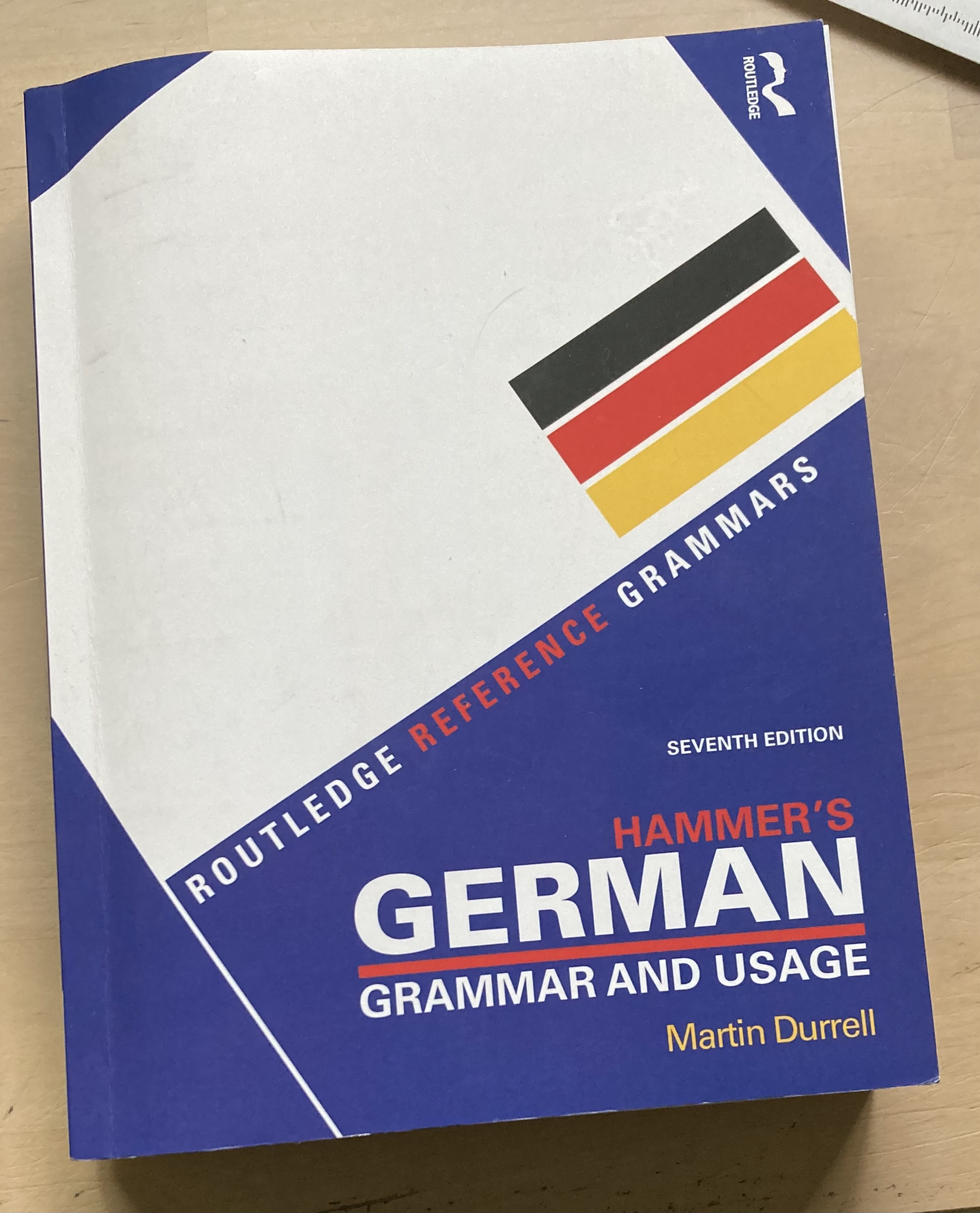
The one I found myself getting most agitated about, though, was using the incorrect form of a past participle (this is sort of an easy one to fix: just study them from a verb book and learn them). I turned to my trusty Hammer’s German Grammar and Usage to look this up, and was reminded that German has two participles that don’t exactly match onto present and past (they call them, instead, Partizip I and Partizip II).
This is such a great book. Clear descriptions, good examples with citations when useful. A lot of people hate using a grammar when they’re learning a language, but I like to be given the why of usage. Proponents of comprehensible input say it’s not necessary, that the grammar will seep into your brain with enough external content, but my brain isn’t as plastic as it was sixty years ago and I’m happy to do my bit to keep Routledge in business… (by the way, that first syllable is pronounced as in a boxing rout not root).