
30 August 26
A Crisis With the Kit
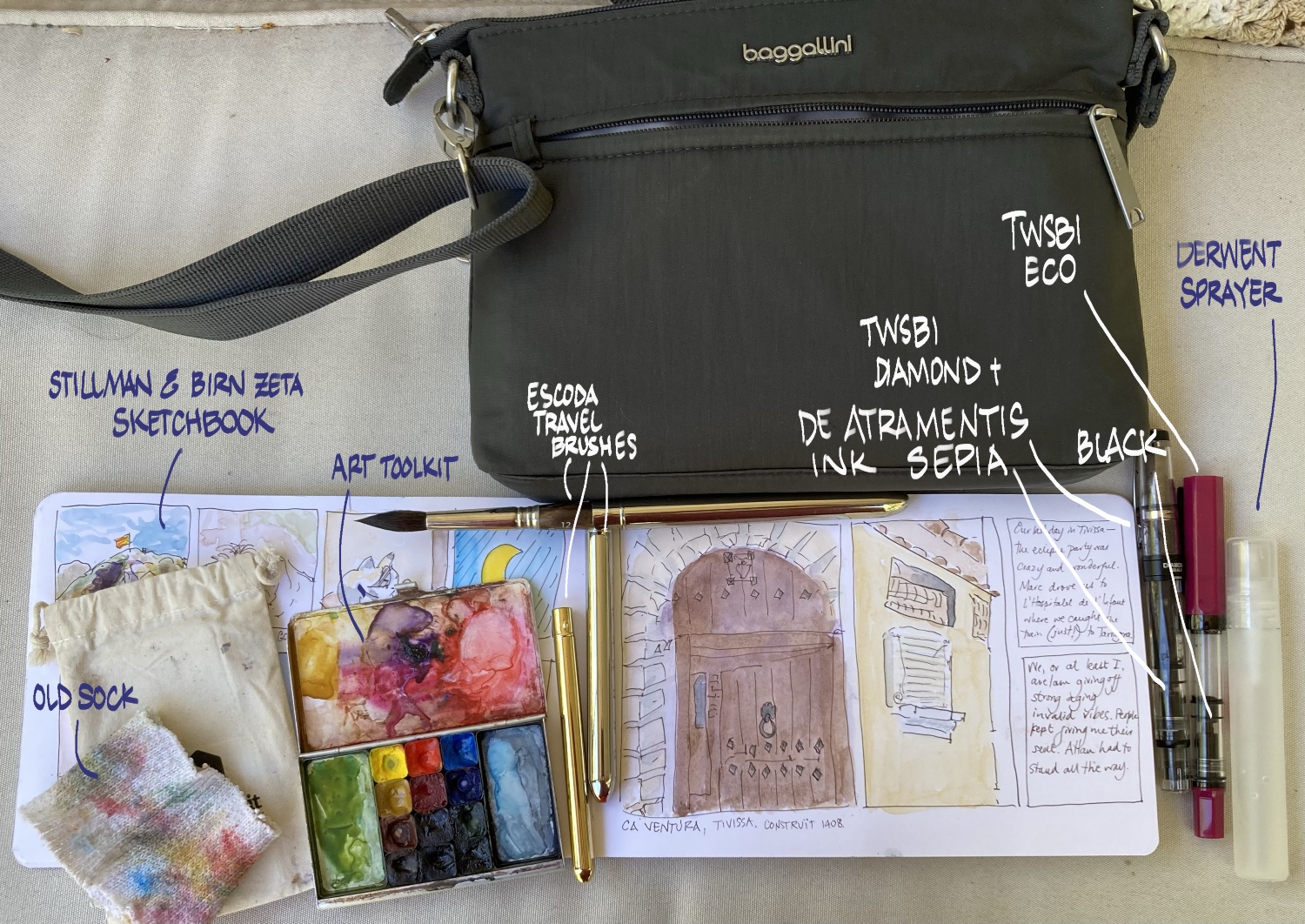 One of the hardest things about packing for a trip is to determine how little you can get away with in the article of art supplies. Both Numenius and I like to sketch in place, with the occasional drawing done after the fact from a photo. This means being nimble — your sketching stuff should be easy to pack and retrieve, light, and as comprehensive as possible.
Although fountain pens in planes can sometimes be disastrous, I’ve found the TWSBI brand loaded with DeAtramentis Document Ink to be very reliable. I like this ink because it’s waterproof: you can sketch in ink then lay in a watercolor wash over the drawing without having it run. The TWSBI Eco has a very large reservoir for ink which lasts a long time.
Unfortunately the TWSBI Diamond isn’t as large and though the nib is delicious on the paper I chose for this trip — Stillman and Birn Zeta — I managed to run out of ink in Tarragona before the trip was over. I’d been using a brown-black (“Sepia”) ink which is new to me from DeAtramentis. I still had a TWSBI Eco loaded with what I thought was Urban Gray, but which turned out to be black, which suddenly felt very harsh. (Stressing out about this kind of thing definitely falls under the category of First World Problems, of interest to maybe three people, but still.)
My attempt to remedy my predicament had us visit “the largest stationery store in Europe,” Raima, in Barcelona. I didn’t find ink there but I picked up a permanent brown marker. This turned out to be too light. We did find a nearby pen store that stocked ink (Platinum, also permanent for fountain pens), but there wasn’t the right brown, and did I really want to buy a whole bottle of ink before I got on a plane? I decided against it. Numenius lent me a Uniball Signo brown-black pen for the rest of the trip which was definitely close in color to what I wanted but I really do prefer to sketch in fountain pen… When we got home I gave my pens a new supply of ink.
You always learn something for the next trip. My favorite place to buy stationery supplies, on this continent, is JetPens, at least where fountain pens and inks are concerned. ETA: forgot to add a link to Art Toolkit which is a fantastic source for pocket-sized travel palettes. I also forgot to add the two waterbrushes I travel with (Pentel Aquash) and a mechanical pencil, which I almost never use.
23 August 26
La Vall de Boí
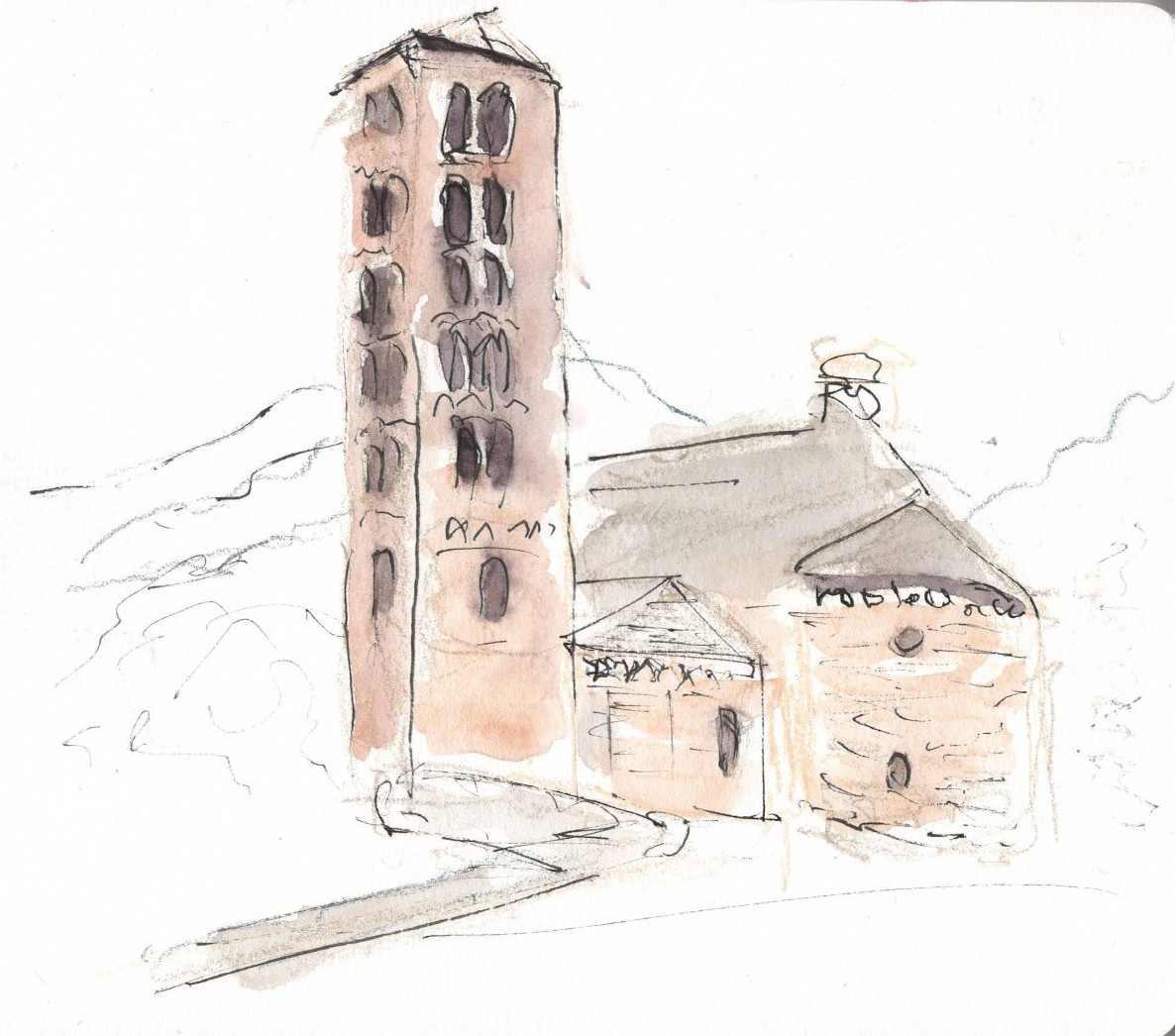 On Sunday two weeks ago we went on an excursion with Jennifer and Harald north into the Pyrenees, Harald having rented a car for the day trip. Our destination was the Vall de Boí, which is a steep-sided valley that is noted for its concentration of Early Romanesque churches: there are nine of these in total in the valley, and the location has been designated a UNESCO World Heritage Site.
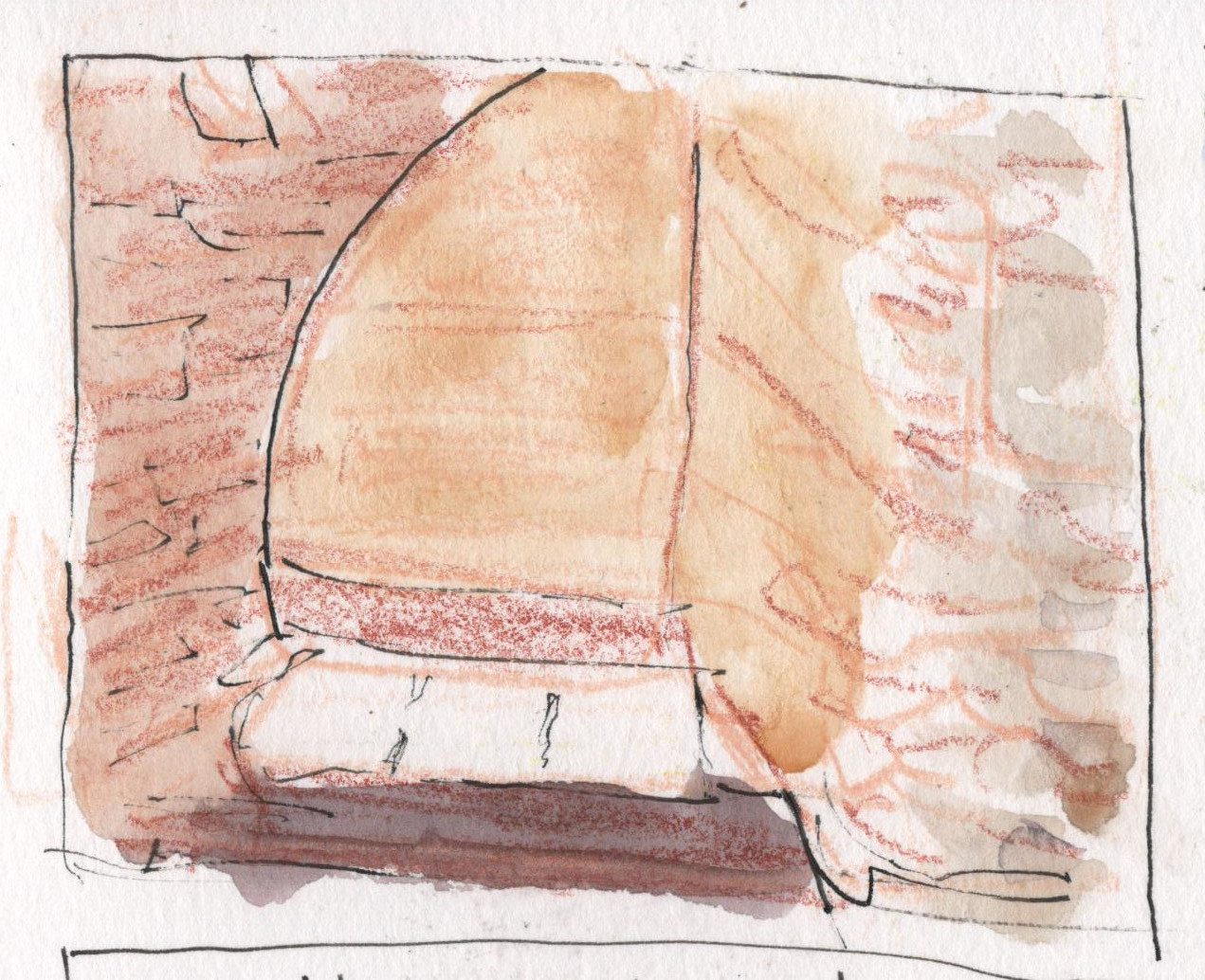
I first heard about the Vall de Boí in a two part episode of El Foraster, a series which proves to be a good guide to finding interesting villages to visit in Catalunya. We went inside two of the churches. The first of these was the church Santa Eulàlia d’Erill la Vall, which is next to the visitors’ center for the site. I went all the way up the six stories of its bell tower. The second church, a bit farther up the valley, was Sant Climent de Taüll which is the largest and best preserved of the churches in the valley. At left is a sketch of the church viewed from the south.
22 August 26
Lleida
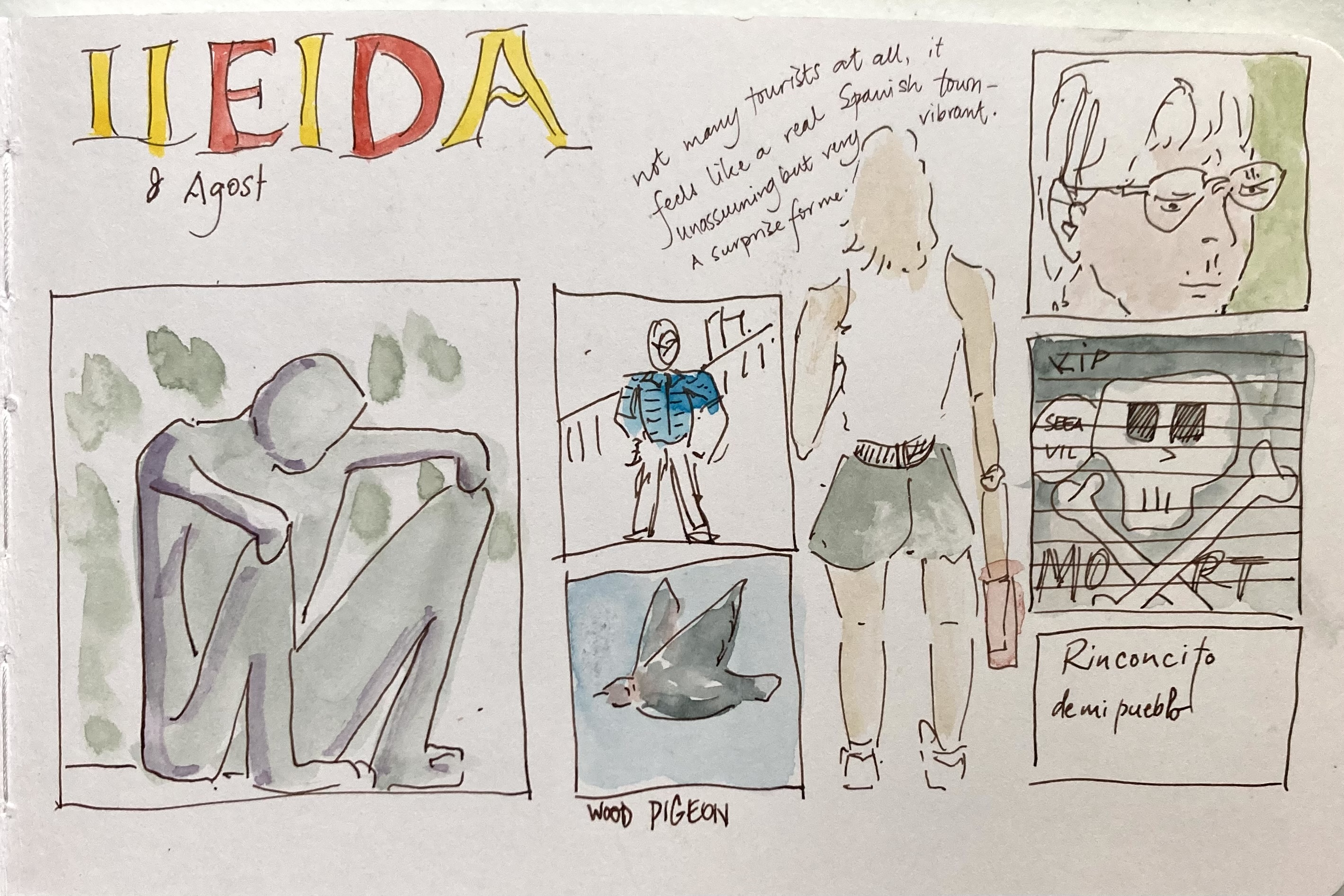 We moved from Girona to Lleida, which is in the western part of Catalunya close to the Pyrenees. We’d had a very positive review of this unassuming city from our friends in Girona, and approaching the city on the train moving through orchards, with a strong Central Valley vibe, we felt very at home.
What I really noticed almost as soon as we arrived was how real the city seemed. Very few tourists — we really stood out — and the lift to the upper levels of the city was being used for inhabitants to navigate their daily lives, rather than for tourists to get up to the cathedral. The city was besieged and bombed heavily in the civil war (1936-39) with the result that the post-war buildings spread out around the central hill and into the ag lands beyond.
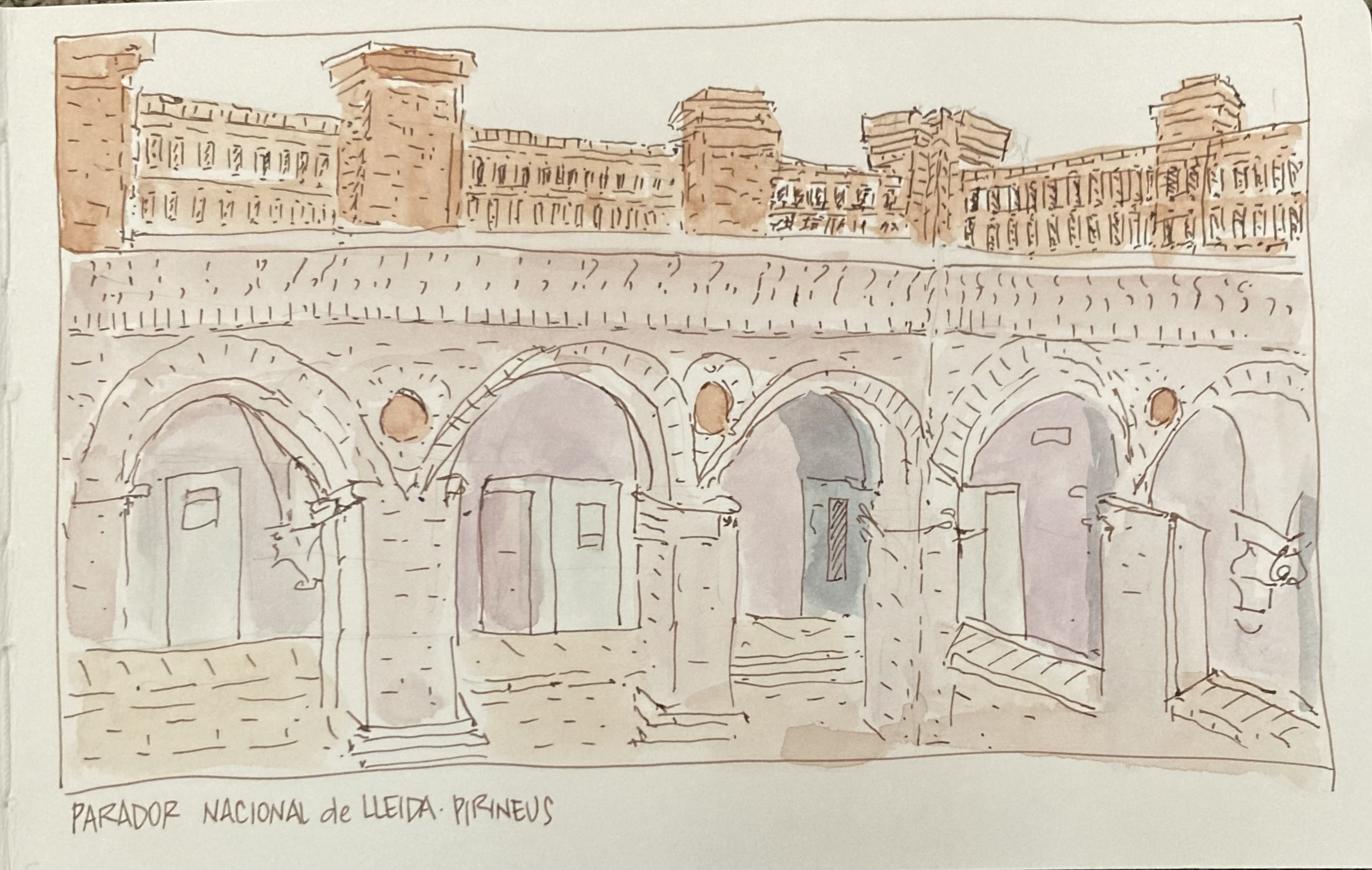
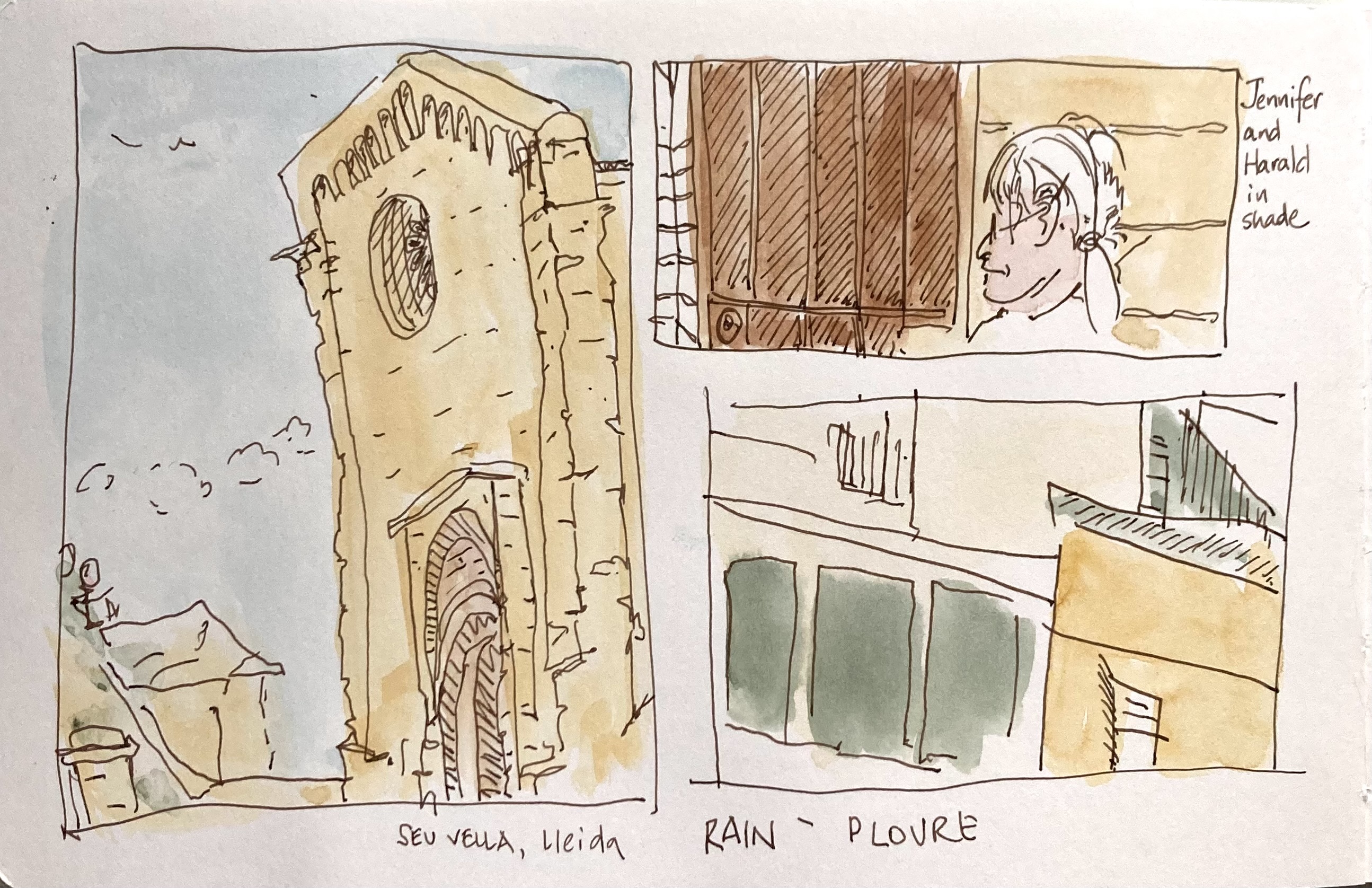 We met some friends in Lleida who live in Sweden but with whom I’d grown up in Madrid. We stayed in a parador, which was a converted convent in the upper level of the town. It was a spectacular setting and for Jennifer and myself a sweetly nostalgic experience. (Jennifer and Harald were given a room with a kettle and we weren’t, with the result that she snuck upstairs in her pyjamas leaving me a thermos of tea outside the door, which was very gratefully received.)
21 August 26
El Call de Girona
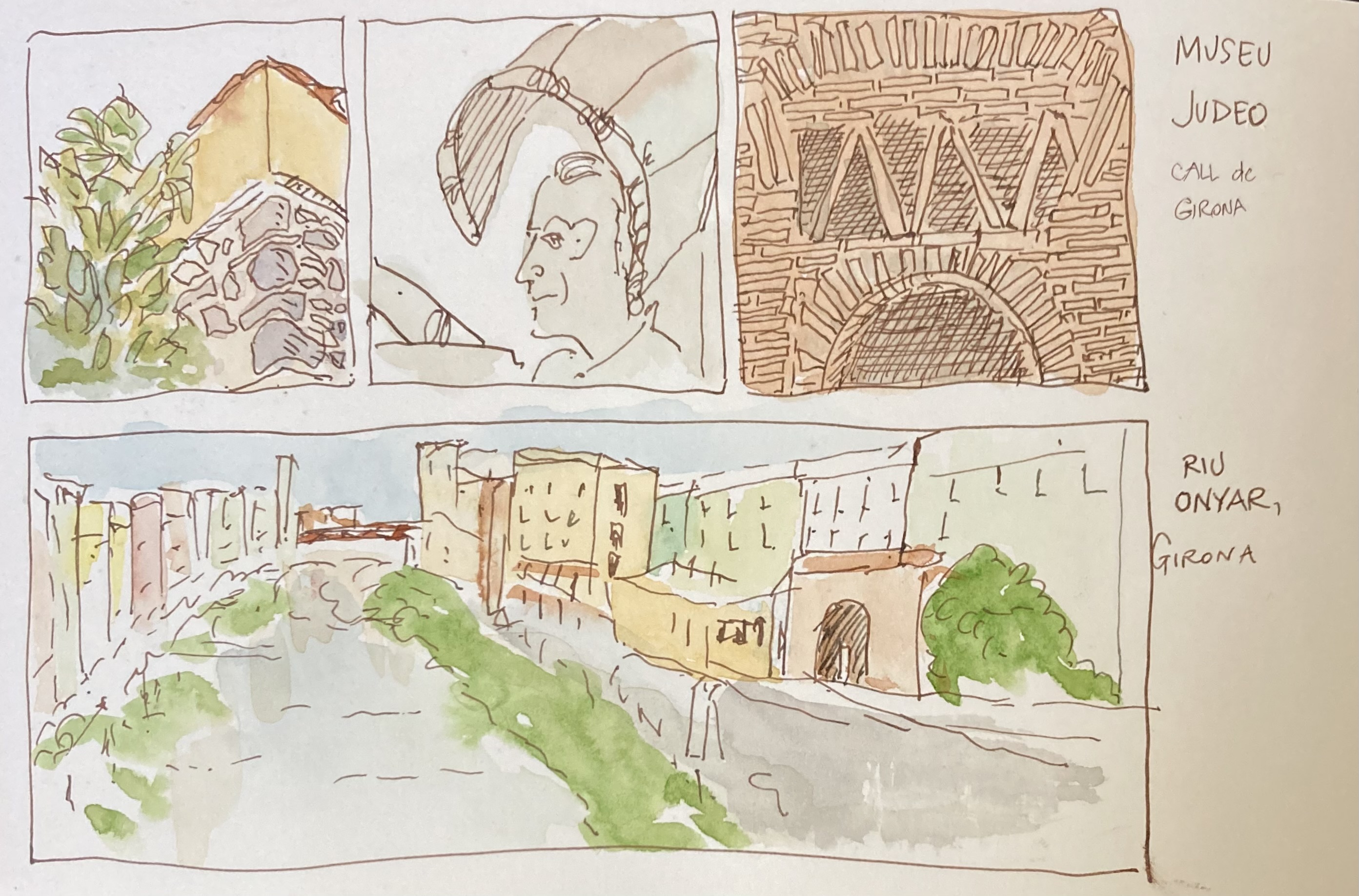
 A highlight of our sojourn in Girona was visiting the medieval Jewish quarter in the old part of the city, which is known as El Call. It is one of the best-preserved medieval Jewish quarters in Europe. Girona was a thriving center of Jewish scholarship; most notably the 13th century scholar Nahmanides lived in Girona most of his life before emigrating to the Holy Land where he established a synagogue in Jerusalem.
We went to the Museum of Jewish History which is housed in a building at the edge of the call. It contains lots of artifacts that were excavated nearby as well as a series of tombstones with inscriptions in Hebrew from a cemetery a couple of kilometers to the north. The museum also contains an excavated mikvah (Jewish ritual bath) from the 15th century that was unveiled to public view in 2014. I’ve illustrated the mikvah at left.
Together with the University of Girona, the museum also hosts the Nahmanides Institute for Jewish Studies, which organizes research and educational activities on Jewish culture both in the Girona area and far beyond, including a long-running lecture series. We did not investigate any of the institute’s activities though.
20 August 26
Girona
After a one-night stop in Barcelona, we moved up toward the Pyrenees to spend three nights in Girona. This is a city on a hill first lived in by Iberians then, like so many settlements in Catalunya, by a succession of Romans, Visigoths, Moors, and finally Christians, the Reconquista of Spain starting in the northwest and spreading south over the course of decades until the capitulation of the Caliphate in Granada in 1492. Much of the successive buildings are intact, and walking up the hill to the cathedral we saw a lot of offices with stone walls in the background, several centuries old, selling insurance or real estate or fans. (Or football shirts.)
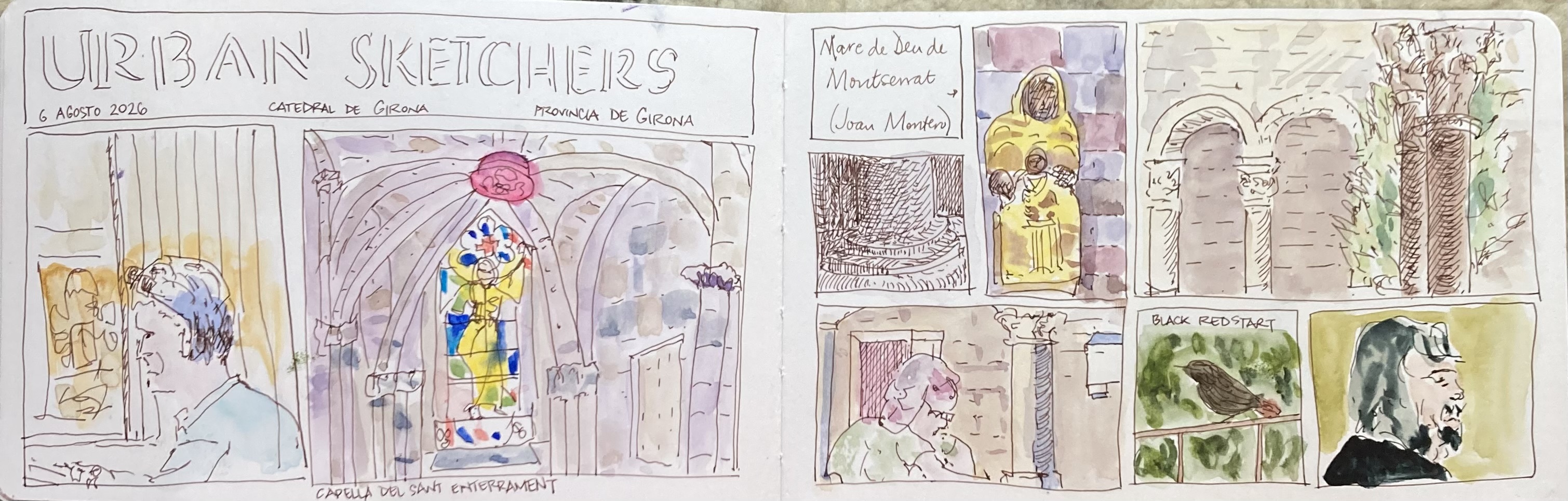
Our trip coincided with the weekly meeting of the Girona Urban Sketchers in the cathedral at the top of the hill. The cathedral’s construction was halted for some time by the arrival of the Black Death, with the result that it ended up being the second widest nave in the world by the time it was finished (after St. Peter’s in Rome). It also never received its second spire. We spent a lovely few hours sketching in and around the cathedral and cloisters.
 Girona has the reputation of being very expensive. It is now a major cycling hub, since many professional cyclists on the grand tour circuit like to train in the mountains; many of the better paid cyclists can afford to live here. A constant refrain throughout our trip was the bemoaning of housing prices that have been driven up by foreigners, many from northern Europe, who earn more than the locals and are having a deleterious effect on prices (and, of course, dilution of the Catalan culture, about which Gironans are especially proud). The Catalan government is very eager to promote Catalan language learning. Another modern office set in a house that was centuries old was a language school, with a request for volunteers to help teach their language.
2 August 26
Farmers Market at 50
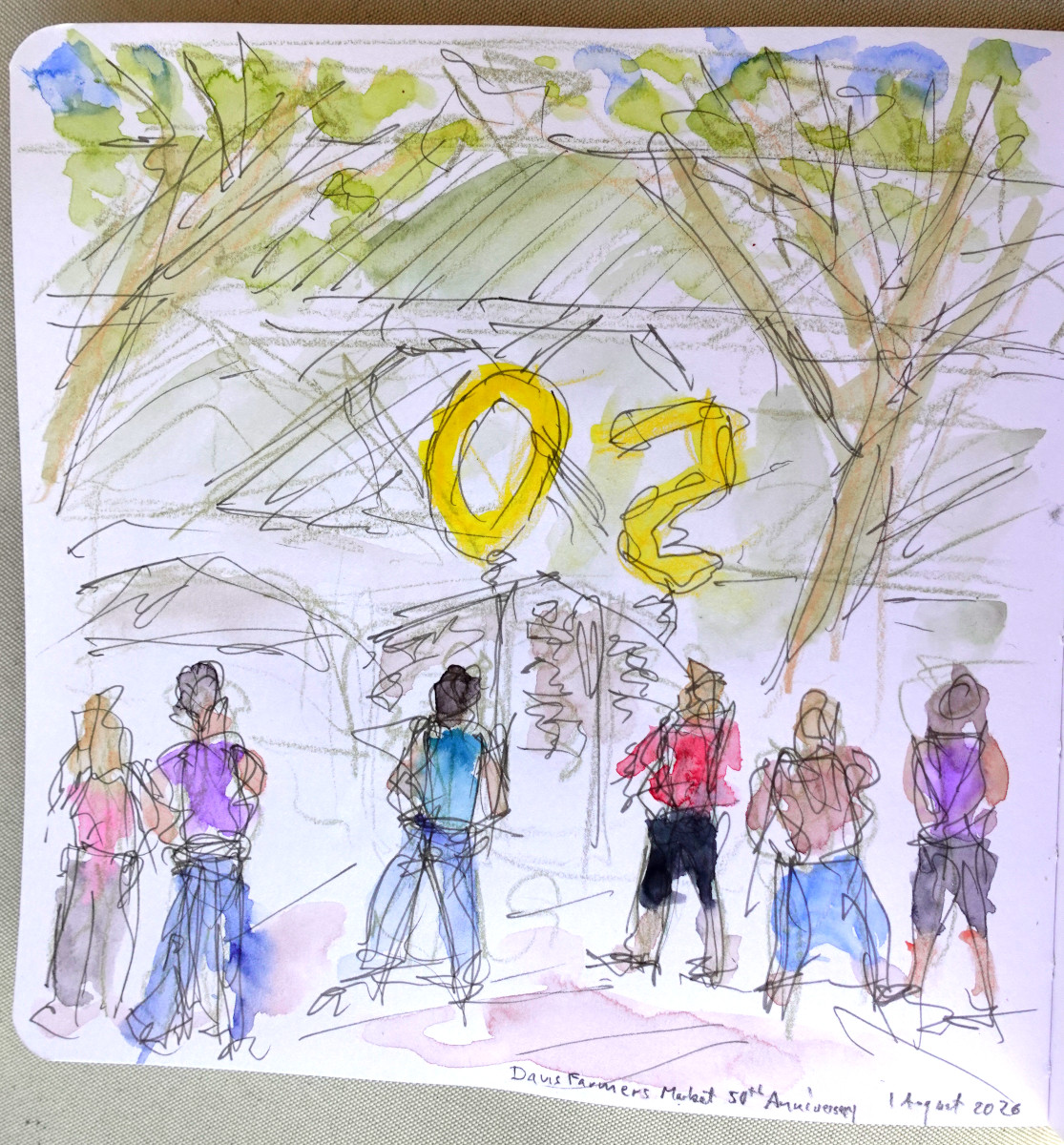 Yesterday the Davis Farmers Market celebrated its 50th anniversary. We had a sketchcrawl at the market for the event. I didn’t stay long at the sketchcrawl, but did complete the sketch at left.
25 July 26
Boxcars
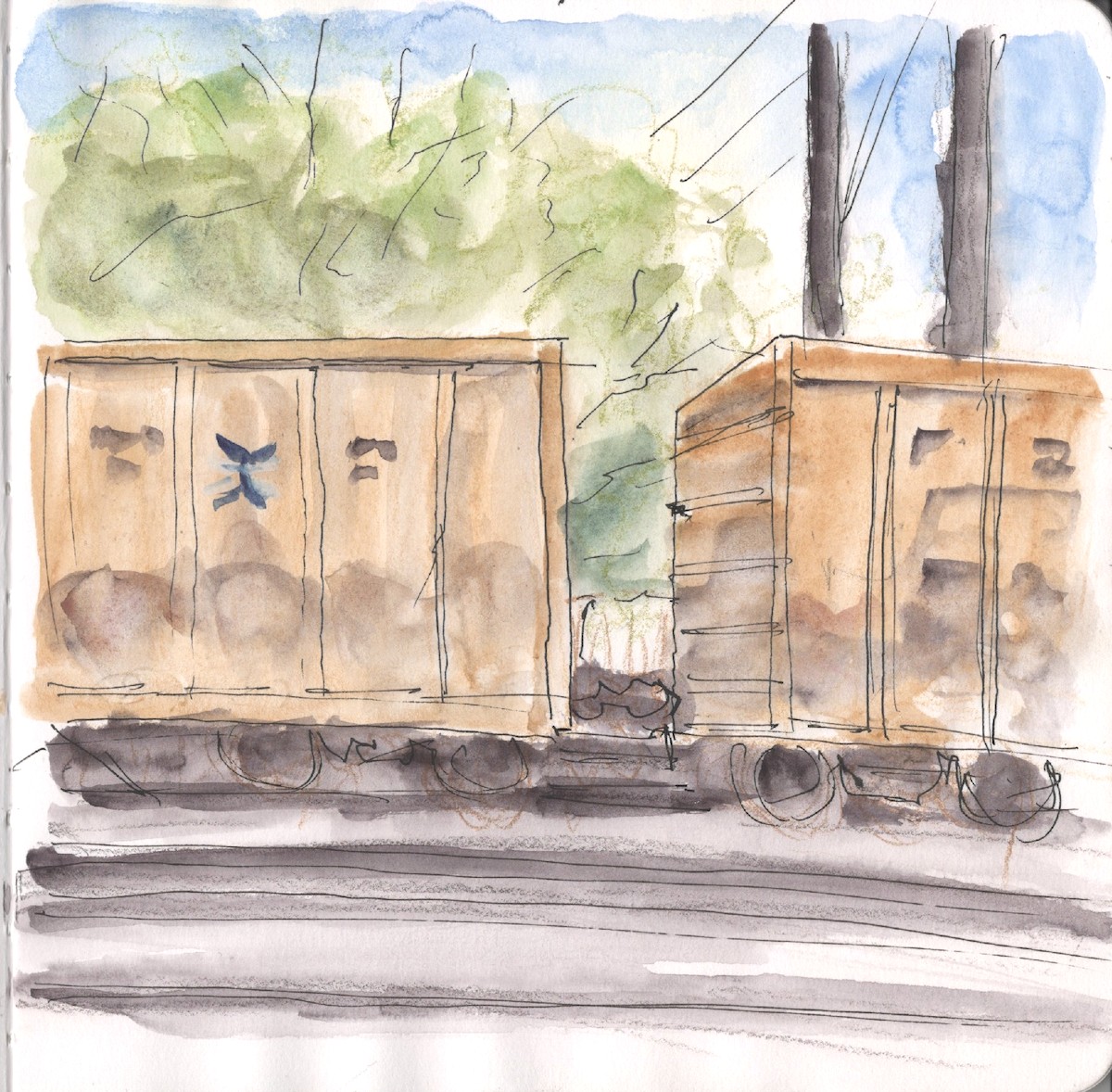 . There is a line of the California Northern Railroad that runs north-south behind the Davis Food Co-op near our house. I often like photographing the freight cars that are parked on this line. For my urban sketch today I drew two of the boxcars linked together and parked near the food co-op.
23 July 26
Scallions For Stirfry
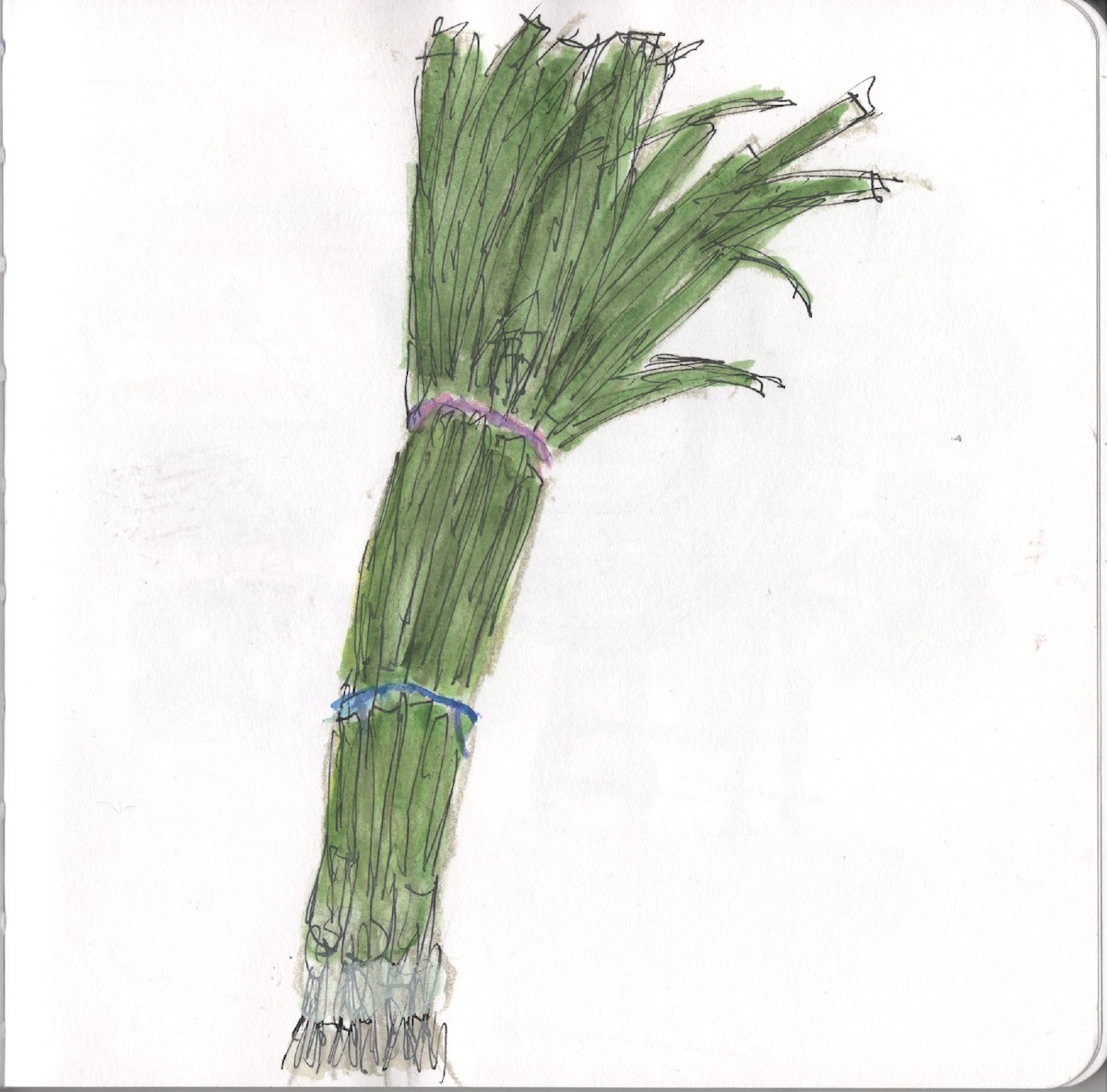 At some point I learned that the combination of scallions, ginger, and garlic is considered the holy trinity of Chinese cooking. Maybe that is so — at any rate it is a key part of a favorite dish of ours that I made for lunch today, called deliciously spicy tofu. The recipe is from Madhur Jaffrey’s Eastern Vegetarian Cooking book (page 201): basically one takes the ginger, garlic, and scallions and stirfry them, adds tofu, and mix in a chili-bean sauce.
As a bonus, scallions, ginger, and garlic are all fun to sketch.
21 July 26
The Old Church
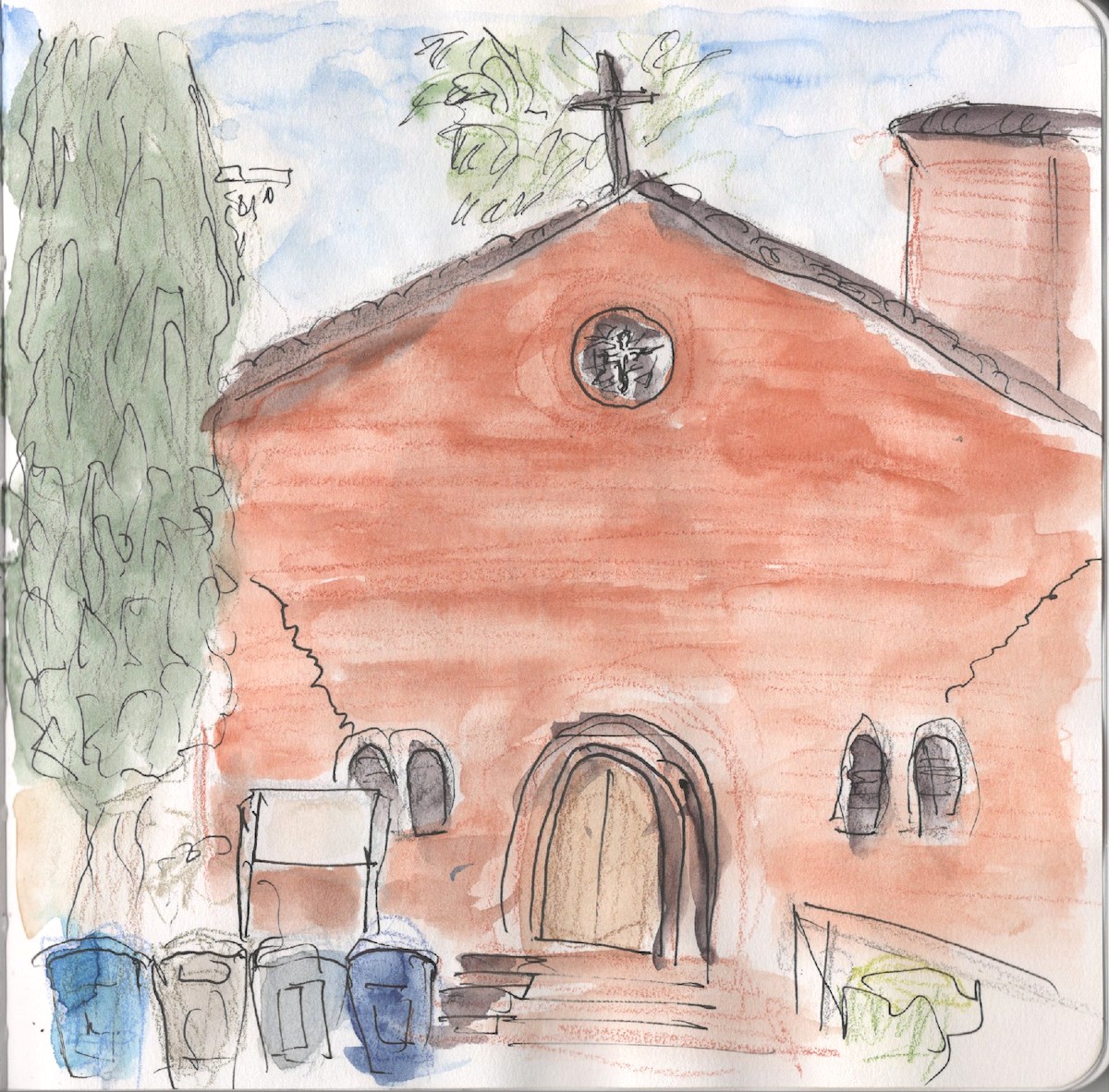 I didn’t get a chance to do my urban sketch on Sunday until after the World Cup final. It was hot and I did not want to wander too far so I sketched the old Newman Catholic Center church at C and 5th. This church was declared structurally unsafe a few years ago and is unused; the congregants meet in newer buildings on the same grounds.
It was advantageous to sketch the church in the late afternoon because I had shade while I was sitting on my stool in a parking lot across the street. I think this is my favorite sketch I’ve done of the church.
17 July 26
(Not) Sharing The Grapes
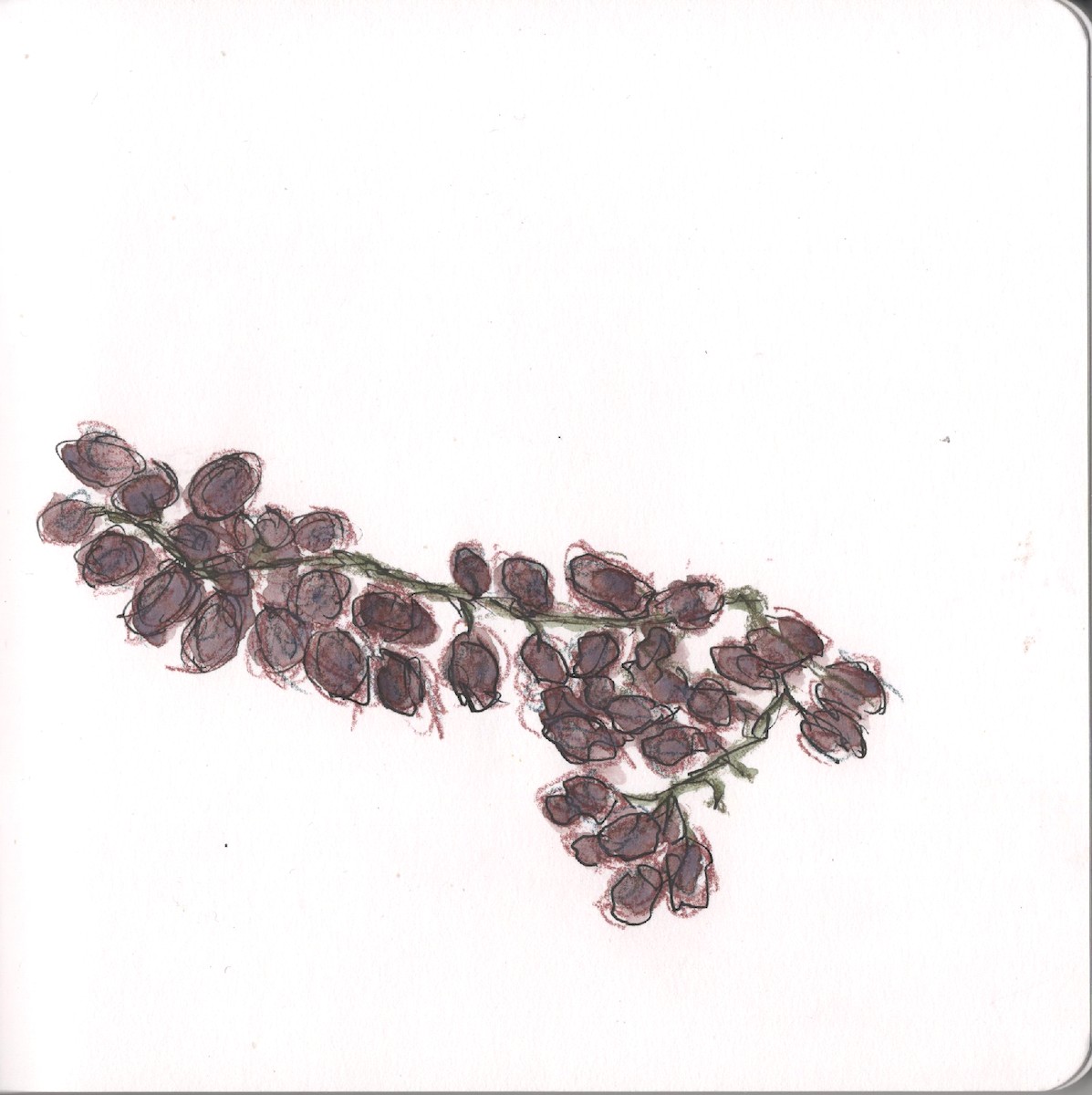 Grapevines overhang the path on the south side of the house, and Pica today noticed a rat raiding the grapes outside the kitchen window. This was not to be allowed, so I collected a grape bunch and later drew it as my sketch of the day.