
28 August 26
Tarragona
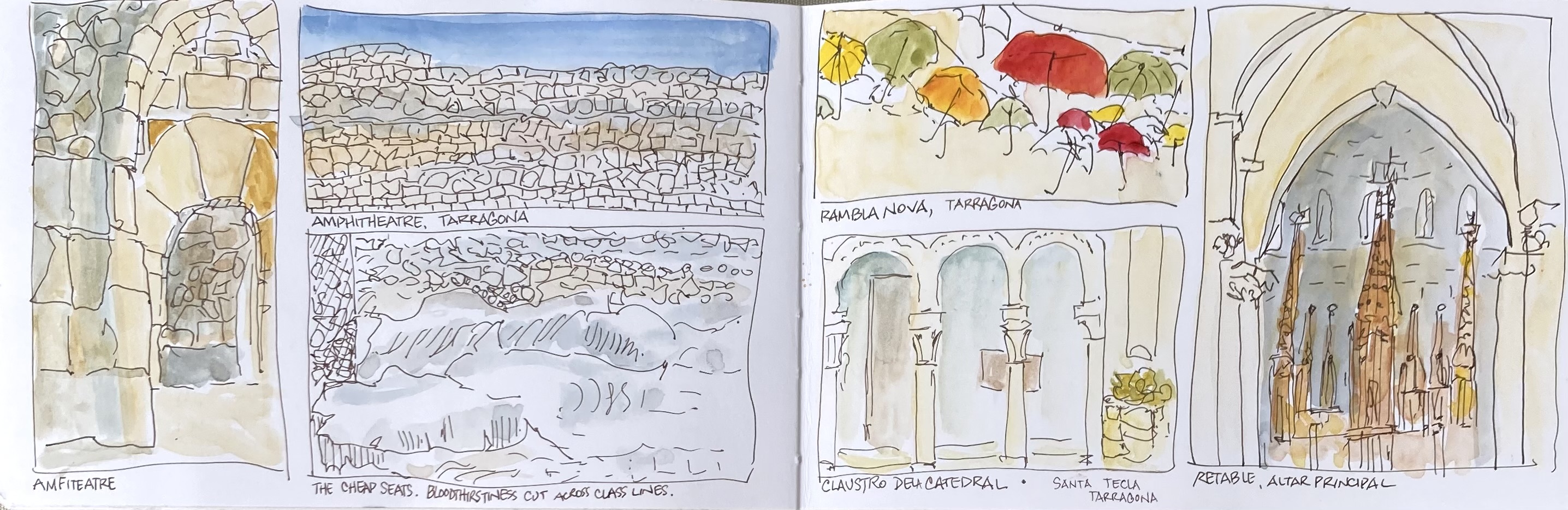
We took the crowded regional train from Hospitalet l’Infant to Tarragona, the capital of Roman Spain. It was hot when we arrived in this beautiful city on the cliffs overlooking the Mediterranean. By luck, we hit the fiesta del Sant Magí, one of the martyrs killed in the Roman amphitheater we visited in the heat of the afternoon. We saw sardanas, the circular Catalan dances, being performed in the main square, and castells — human pyramids — precariously erecting themselves in front of one of the churches. And we took ourselves to the Cathedral for some more cloister sketching. (We encountered two separate couples getting their wedding photographs taken at the Cathedral, which was entertaining for us if not them.) The cathedral was built on the site of the Augustan temple of Tarraco and is dedicated to Santa Tecla (also martyred, though not in Tarragona). The word “tecla” in Spanish means key, as in keys on a keyboard. I’ve yet to discover whether there is any connection between them…
27 August 26
An Interlude On Public Transport
Apart from the excursion up to Vall de Boí via rental car, basically all of travels throughout Catalunya were via public transport. How did this go?
The train (Renfe). Train service in Spain in general and Catalunya specifically can be divided into high-speed rail (the AVE) and regional rail lines. Spain has invested a lot into building out the AVE — Spain has more mileage of high-speed rail lines than any other country besides China — but this has been at the cost of lack of investment in the regional rail network. We rode the AVE twice, once to go from Barcelona to Girona, and the other time to go from Girona to Lleida. These trips were fast as advertised but navigating the stations, particularly Barcelona-Sants, was tricky. We rode the regional rail three times: first to get from Barcelona airport to downtown, then to go from L’Hospitalet d’Infant to Tarragona, and then from Tarragona to Barcelona. The latter two trips were miserably overcrowded and I had to stand all the way both legs. The trains however were on time. There was an episode of Easy Catalan a year ago where the hosts interviewed people on the street in Vilafranca del Penedès on whether they took the train anywhere. The answer was almost without exception no, the trains in Catalunya were just too slow and unreliable.
The metro in Barcelona. We rode it extensively the last three days of our trip. It is a large system and we found that changing between lines took a lot of effort in going up and down to the different underground levels via escalator or elevator. Our base for our stay in Barcelona was a hotel on the metro line running directly to the airport so we had to do a lot of line changing. We also learned that summertime is when they do maintenance on the system; specifically on our first trip from the hotel to downtown we discovered that the L1 line which had the easiest interconnection to downtown was closed for five stations, replaced by a special bus. We then had to route around this discontinuity in the metro lines the rest of our stay. One thing that made our travels easier in Barcelona was buying a three-day Hola Barcelona pass, unlimited travel for that time period on the city buses and the metro. Another fun diversion was taking the funicular up Montjuïc that is directly connected to the metro system.
Buses. They are harder to research than trains or the metro but the buses can be quite enjoyable. Returning to our hotel in Barcelona the last day we found a bus that ran from Paral·lel straight to our hotel — it was much more efficient than the metro plus it skirted the lower slopes of Montjuïc, passing by some magnificent architecture on the way. And my favorite transit experience the entire stay in Catalunya was taking the bus from Lleida south to Mora d’Ebre. There are only two buses a day on that route but the trip passed through some really interesting countryside. Also the bus station in Lleida is right next to the train station which is quite convenient.
Taxis. We used these fairly often for short legs. In general taxis are easily found but we had a stressful twenty minutes waiting for a summoned taxi to take us from our hotel in Girona to the train station to catch the AVE.
All of which has taught me to pay more attention to bus transport while traveling. A good guide for researching buses worldwide is busmaps.com. As an example, this shows all the agencies running buses through Lleida.
26 August 26
Eclipse Party
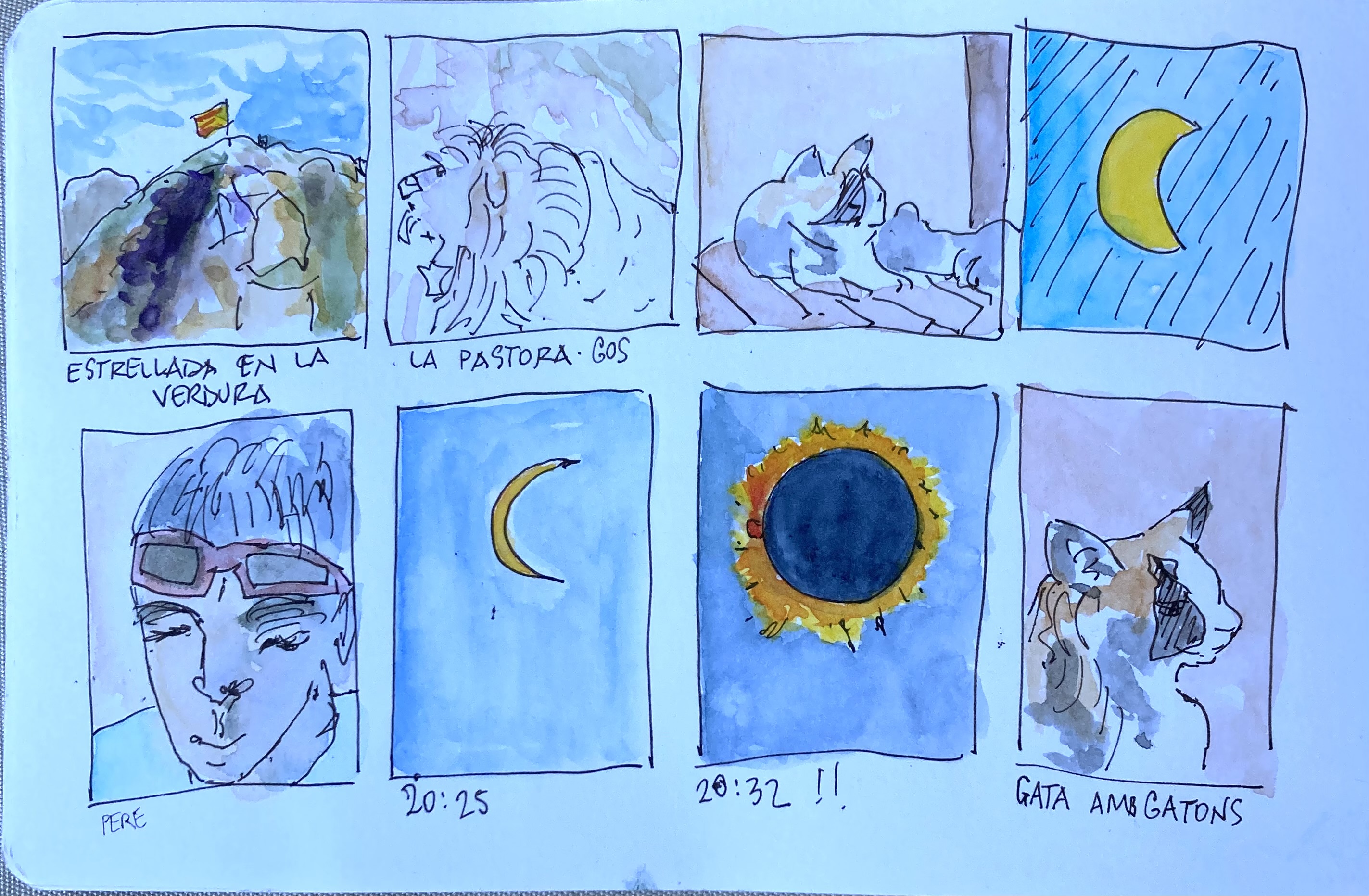 One of the main reasons to go to Spain in the height of summer was to see the total solar eclipse of August 12. We knew two years ago, when our Catalan friends still lived in Davis, that the eclipse would be total in Tivissa in the early evening, and we made plans to visit them back then.
In the couple of days leading up to the 12th we were worried there would be cloud cover in the afternoon. But neither of us had the inclination to go chasing for clear skies. In the event it was perfectly clear and we were invited over to the house of some friends of Marc and Ruth’s for dinner and an eclipse party. We could hear the merriment across the way from the main square. I have never seen a total solar eclipse before and it definitely exceeded my expectations.
It was quite the festive occasion. Numenius got interviewed by the local Tivissa YouTuber and appears on this video at 2:34. (There are some still photos later on in the video that show us on the patio watching the eclipse, see 32:30 and 35:54.)
25 August 26
Ermita de Sant Blai
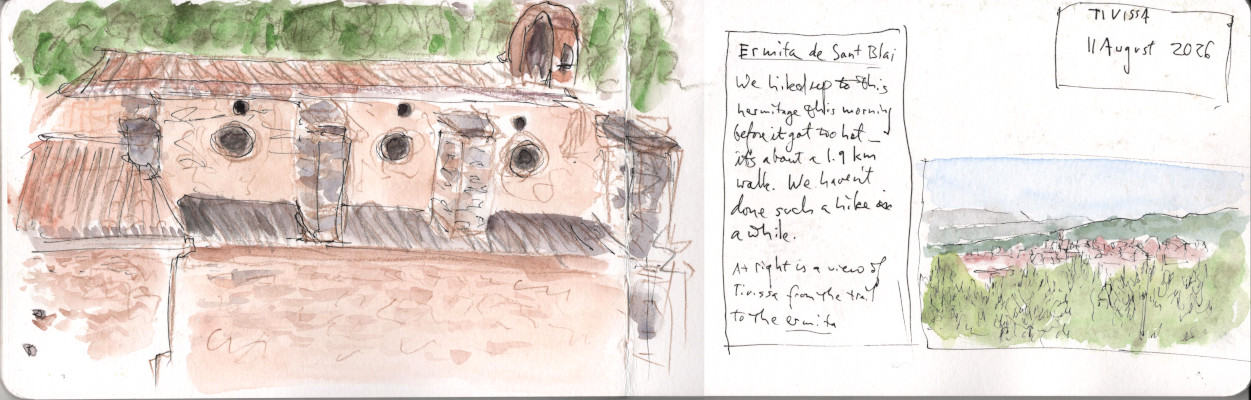
On Tuesday two weeks ago we went on a little hike from Tivissa up to the Ermita de Sant Blai. This is a small chapel high up in the forests overlooking the town that was built sometime in the 19th century on top of an older site. A couple hundred meters down the trail from the ermita is a spring with a basin and three faucets. At the ermita we saw beeeaters flying overhead, much to Pica’s delight — this was the bird that got her interested in birding as a child.
Sketched above is the ermita, together with a view of Tivissa looking back from the trail.
24 August 26
Tivissa
We left Lleida on a bus to take us to Mora d’Ebre, a town on the major river of the region which was used as a principal mode of grain transport by the Romans. Our Davis Catalan friends live in Tivissa, on a hill overlooking the Ebro valley. We were privileged to get a glimpse of their day-to-day lives, which were quite hectic given that Marc is in charge of wildfire response in this part of the country and a major fire had just broken out.
 I haven’t spent much time in a Spanish village since the 1970s and I’m happy to report that not a lot has changed since then. I mean you don’t have to book a phone call to the outside world and everyone has internet, but wandering around, knowing all your neighbors and their kids and their cousins, buying fruit at the market and bread at the baker — this was all very familiar. Marc and Ruth own the oldest house in the village, built in 1408 on top of a Moorish house (a front courtyard was added and walled in). The house next to theirs was hit by Napoleon’s artillery fire and burned down during the Peninsular war. Marc explained to us that brick archways in the village denote Moorish doorways, stone ones medieval Christian. A combination of the brick arch and stone columns denotes a Muslim who had converted to Christianity (with the Catholic monarchs’ edict of 1492, to convert or leave, this was something of an expedient). The straight Roman streets curved and clustered in the middle ages to aid in defense of the village, where marauding armies could be stopped before building up attacking speed. (The house had a curious raised doorway, which was used by the resident knight in armor to be able more easily to mount his horse.)
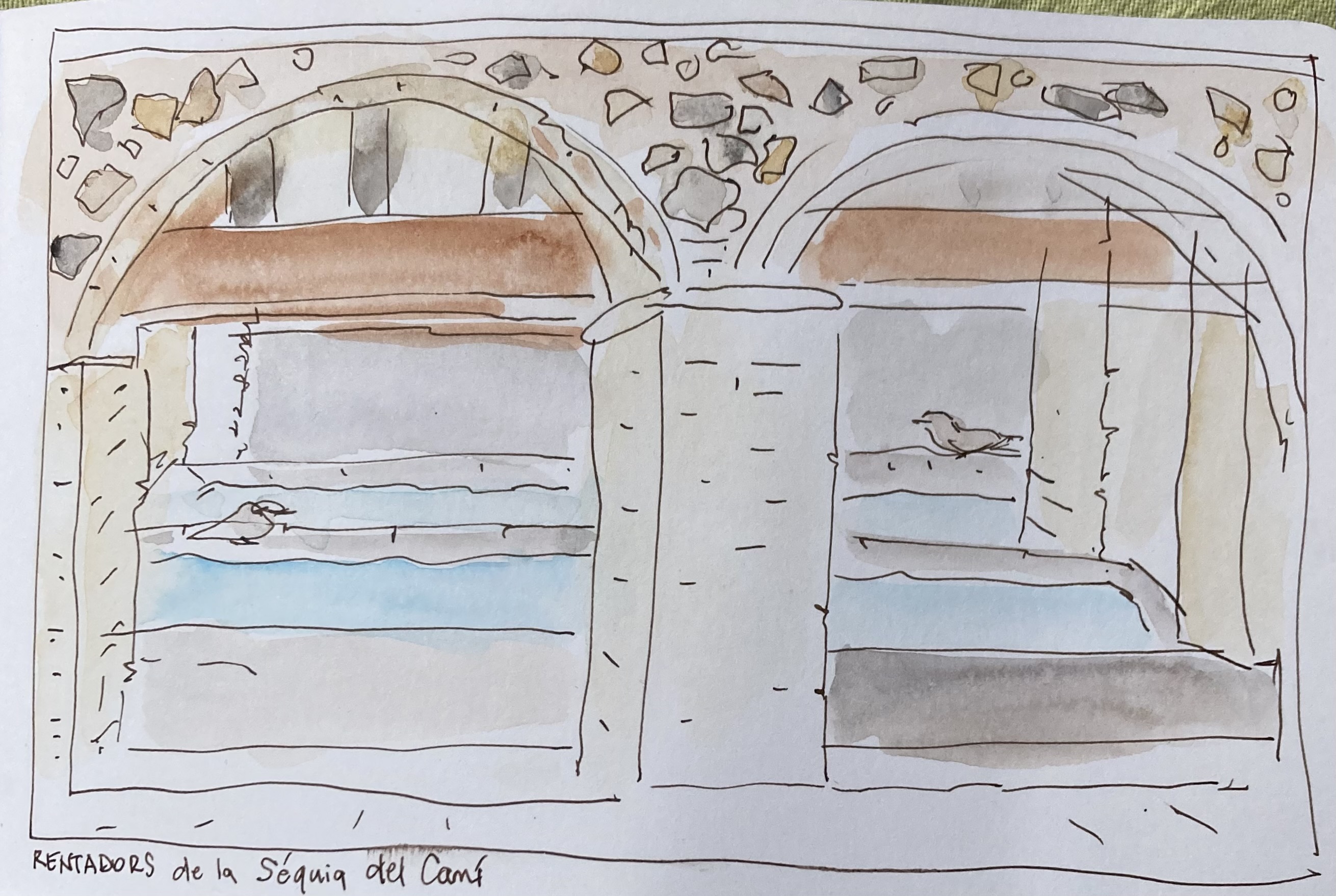
One of the most fun things about staying here was that as soon as we got our sketchbooks out, the three kids started drawing with us. We spent a lovely quarter hour or so drawing the 19th-century wash house (pictured at right) with Teresa, age six, after the boys had finished their football match.
23 August 26
La Vall de Boí
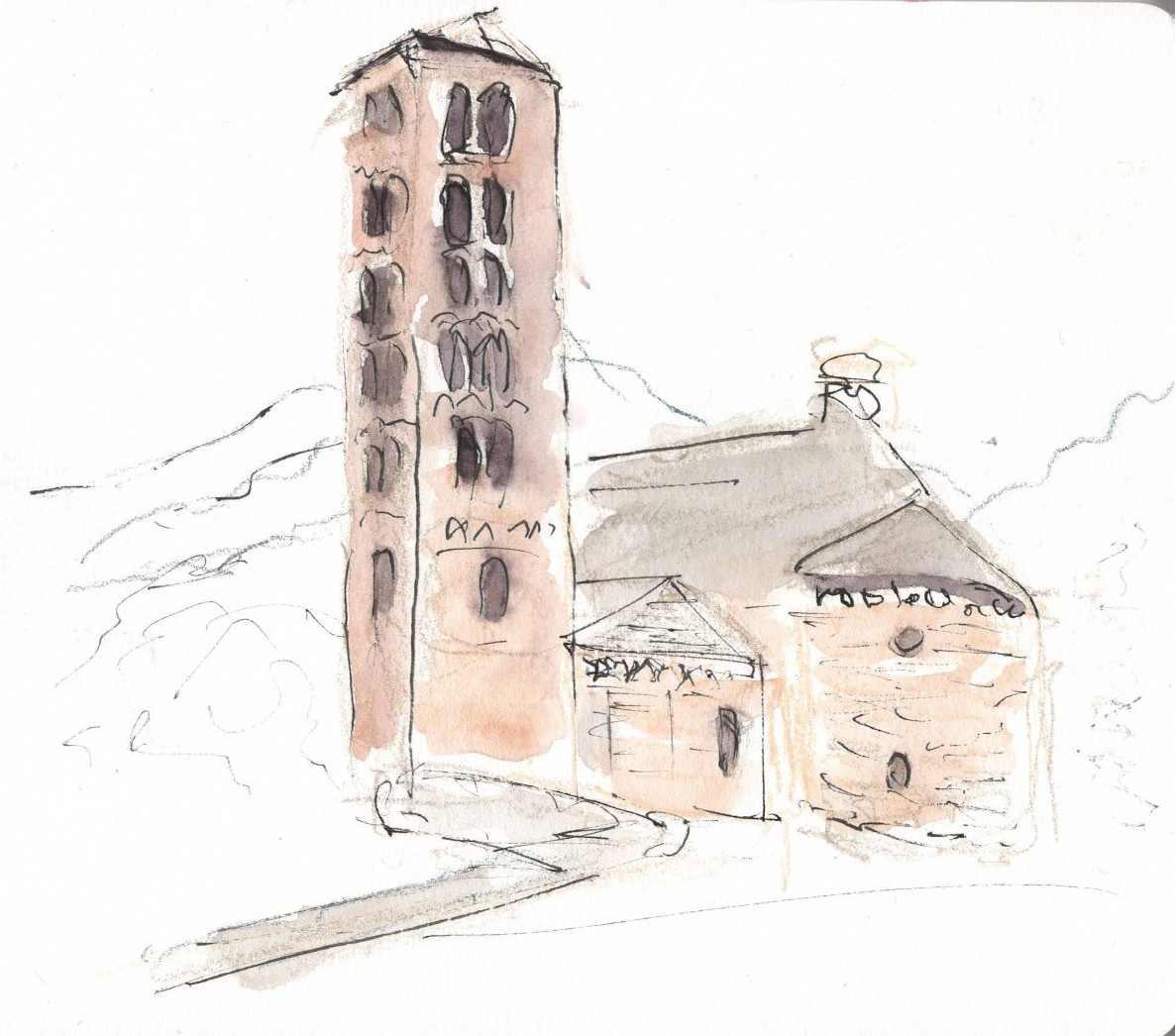 On Sunday two weeks ago we went on an excursion with Jennifer and Harald north into the Pyrenees, Harald having rented a car for the day trip. Our destination was the Vall de Boí, which is a steep-sided valley that is noted for its concentration of Early Romanesque churches: there are nine of these in total in the valley, and the location has been designated a UNESCO World Heritage Site.
I first heard about the Vall de Boí in a two part episode of El Foraster, a series which proves to be a good guide to finding interesting villages to visit in Catalunya. We went inside two of the churches. The first of these was the church Santa Eulàlia d’Erill la Vall, which is next to the visitors’ center for the site. I went all the way up the six stories of its bell tower. The second church, a bit farther up the valley, was Sant Climent de Taüll which is the largest and best preserved of the churches in the valley. At left is a sketch of the church viewed from the south.
22 August 26
Lleida
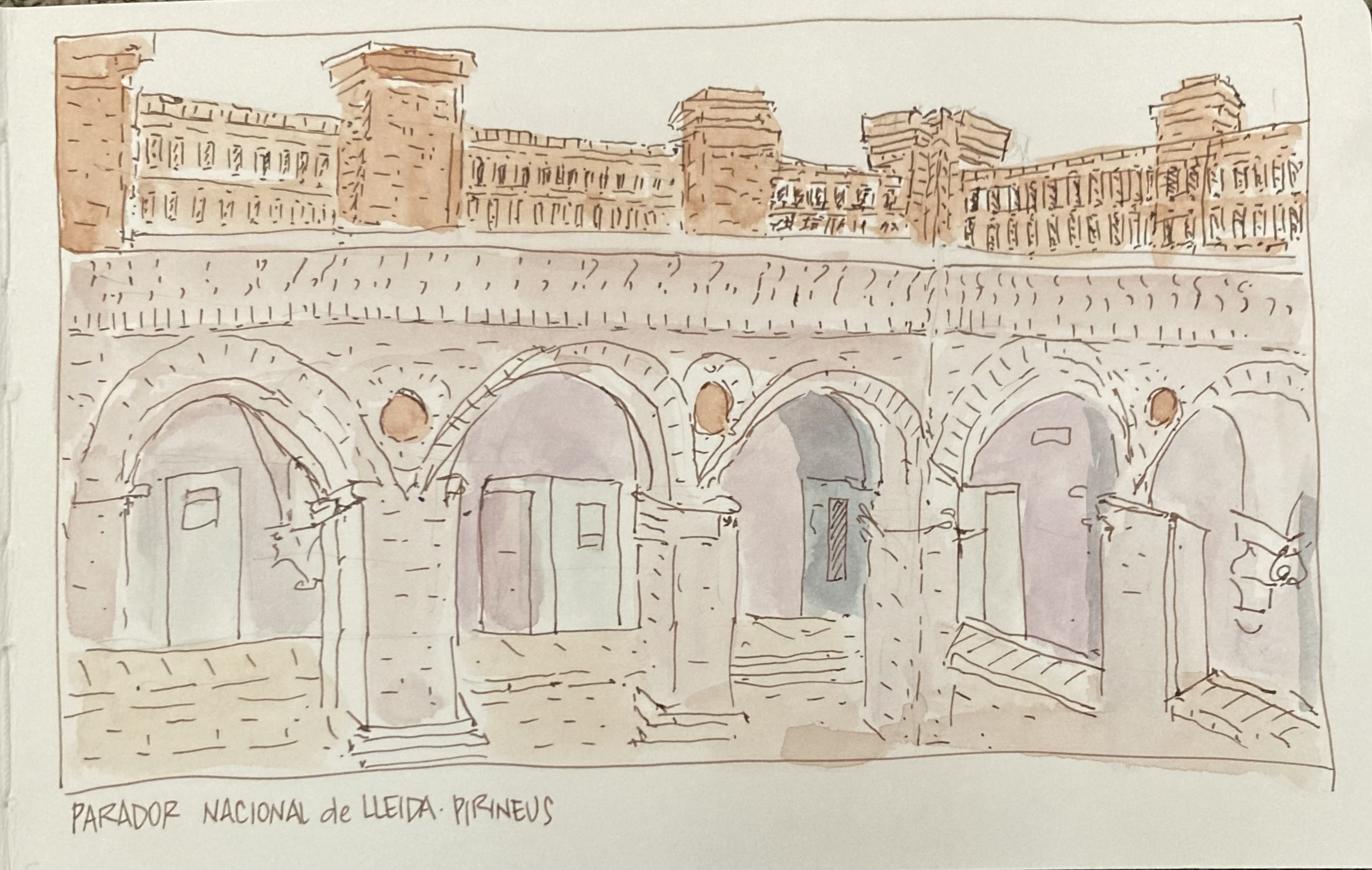
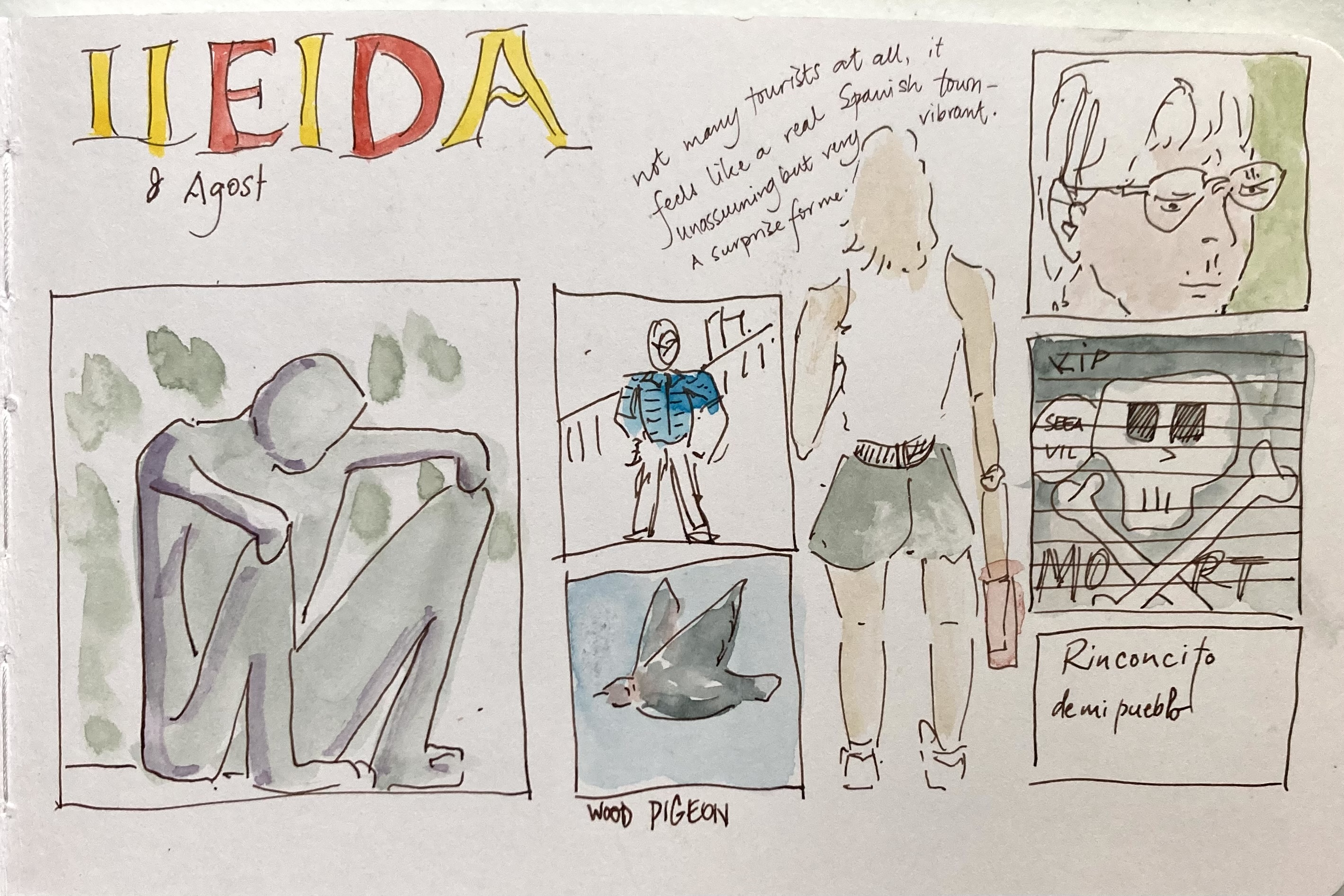 We moved from Girona to Lleida, which is in the western part of Catalunya close to the Pyrenees. We’d had a very positive review of this unassuming city from our friends in Girona, and approaching the city on the train moving through orchards, with a strong Central Valley vibe, we felt very at home.
What I really noticed almost as soon as we arrived was how real the city seemed. Very few tourists — we really stood out — and the lift to the upper levels of the city was being used for inhabitants to navigate their daily lives, rather than for tourists to get up to the cathedral. The city was besieged and bombed heavily in the civil war (1936-39) with the result that the post-war buildings spread out around the central hill and into the ag lands beyond.
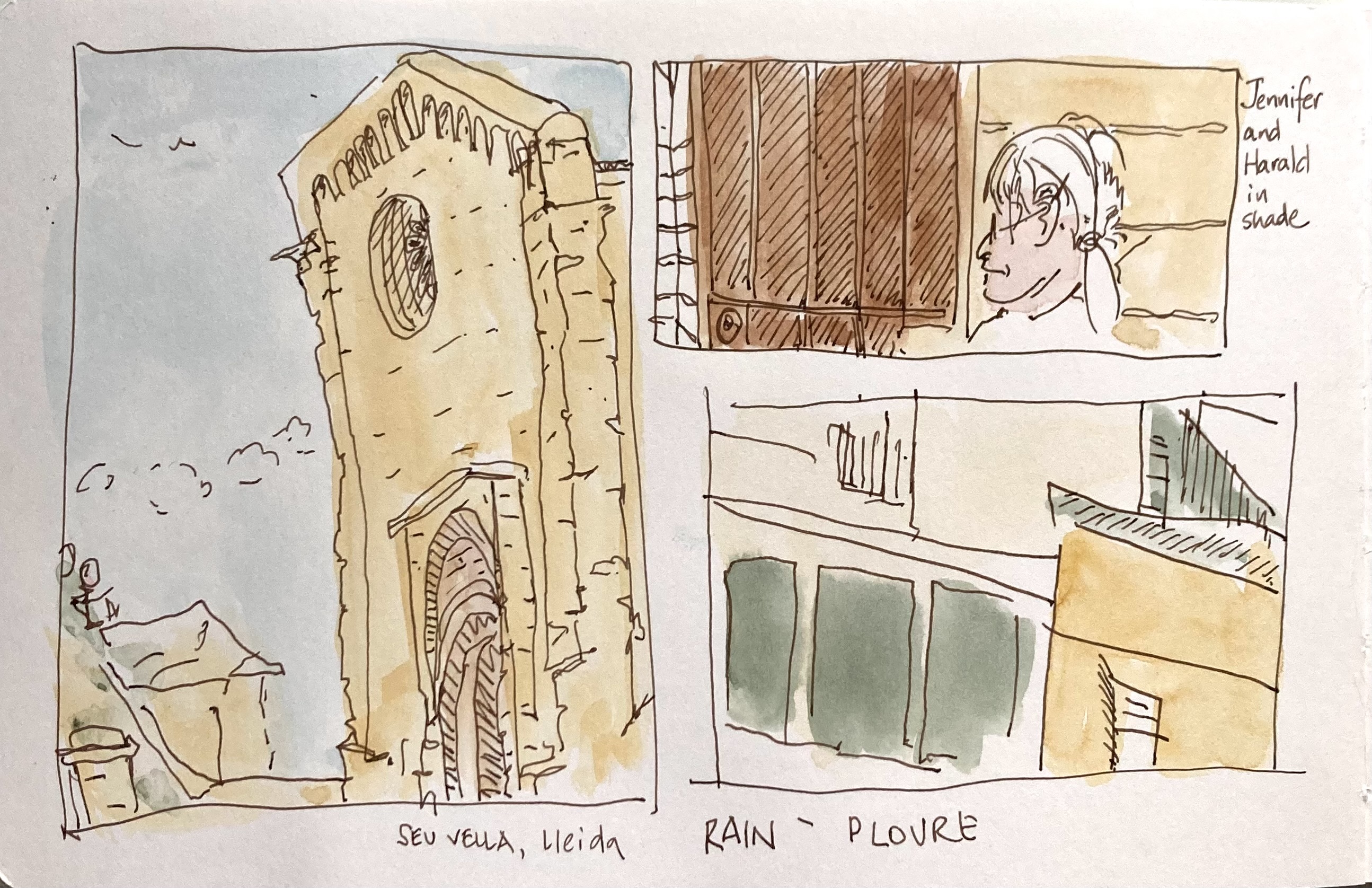 We met some friends in Lleida who live in Sweden but with whom I’d grown up in Madrid. We stayed in a parador, which was a converted convent in the upper level of the town. It was a spectacular setting and for Jennifer and myself a sweetly nostalgic experience. (Jennifer and Harald were given a room with a kettle and we weren’t, with the result that she snuck upstairs in her pyjamas leaving me a thermos of tea outside the door, which was very gratefully received.)
21 August 26
El Call de Girona
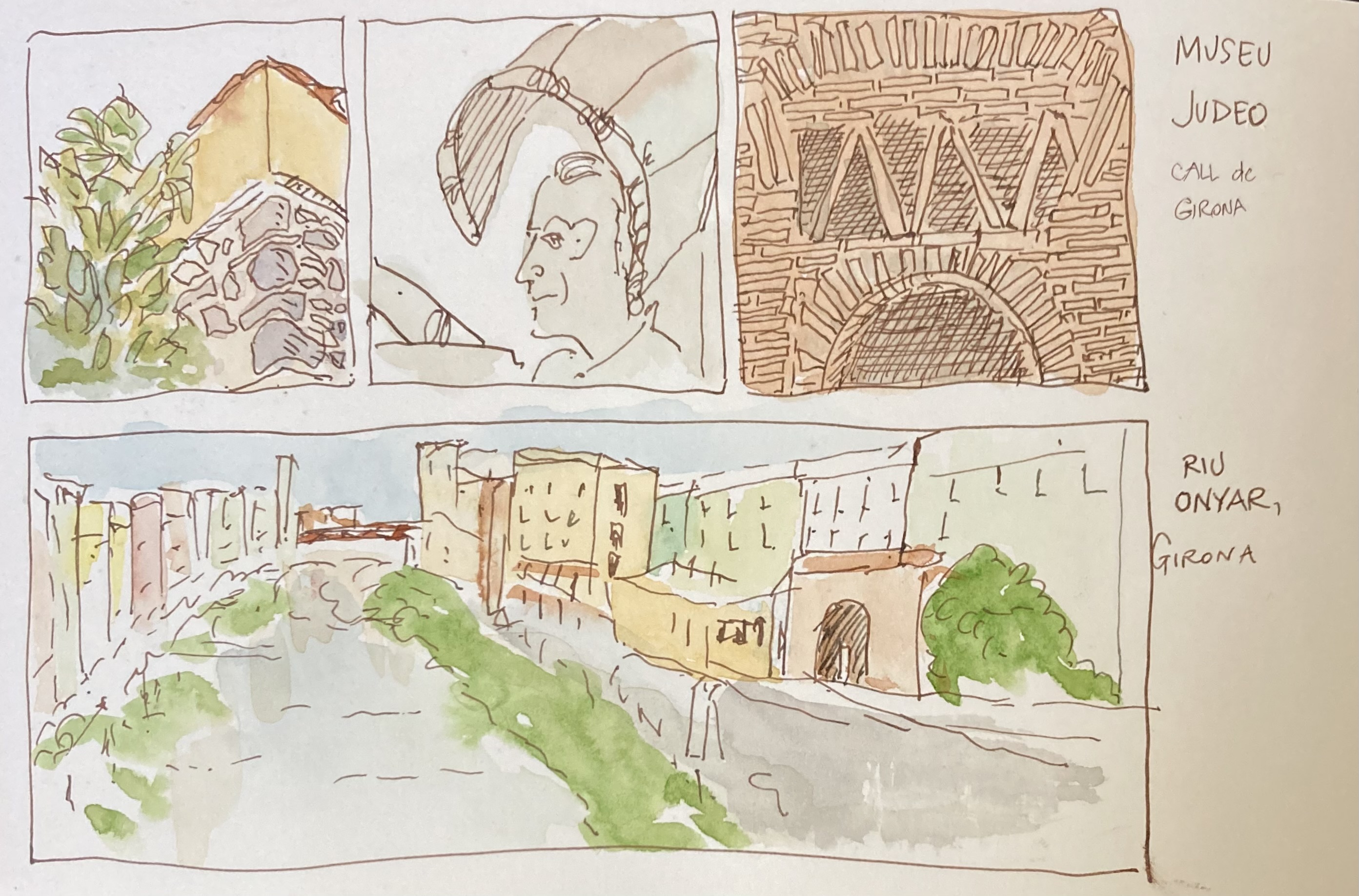
 A highlight of our sojourn in Girona was visiting the medieval Jewish quarter in the old part of the city, which is known as El Call. It is one of the best-preserved medieval Jewish quarters in Europe. Girona was a thriving center of Jewish scholarship; most notably the 13th century scholar Nahmanides lived in Girona most of his life before emigrating to the Holy Land where he established a synagogue in Jerusalem.
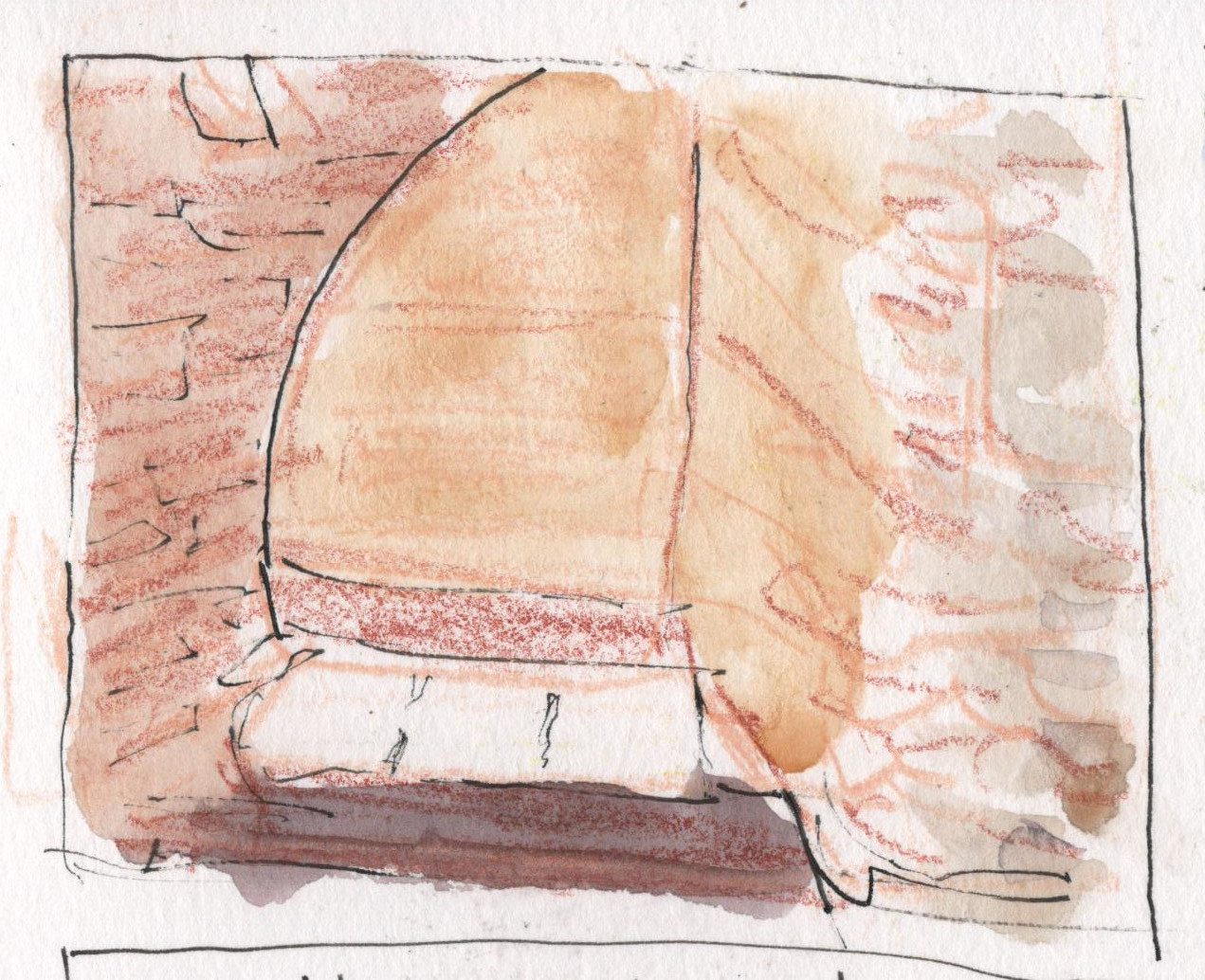
We went to the Museum of Jewish History which is housed in a building at the edge of the call. It contains lots of artifacts that were excavated nearby as well as a series of tombstones with inscriptions in Hebrew from a cemetery a couple of kilometers to the north. The museum also contains an excavated mikvah (Jewish ritual bath) from the 15th century that was unveiled to public view in 2014. I’ve illustrated the mikvah at left.
Together with the University of Girona, the museum also hosts the Nahmanides Institute for Jewish Studies, which organizes research and educational activities on Jewish culture both in the Girona area and far beyond, including a long-running lecture series. We did not investigate any of the institute’s activities though.
20 August 26
Girona
After a one-night stop in Barcelona, we moved up toward the Pyrenees to spend three nights in Girona. This is a city on a hill first lived in by Iberians then, like so many settlements in Catalunya, by a succession of Romans, Visigoths, Moors, and finally Christians, the Reconquista of Spain starting in the northwest and spreading south over the course of decades until the capitulation of the Caliphate in Granada in 1492. Much of the successive buildings are intact, and walking up the hill to the cathedral we saw a lot of offices with stone walls in the background, several centuries old, selling insurance or real estate or fans. (Or football shirts.)
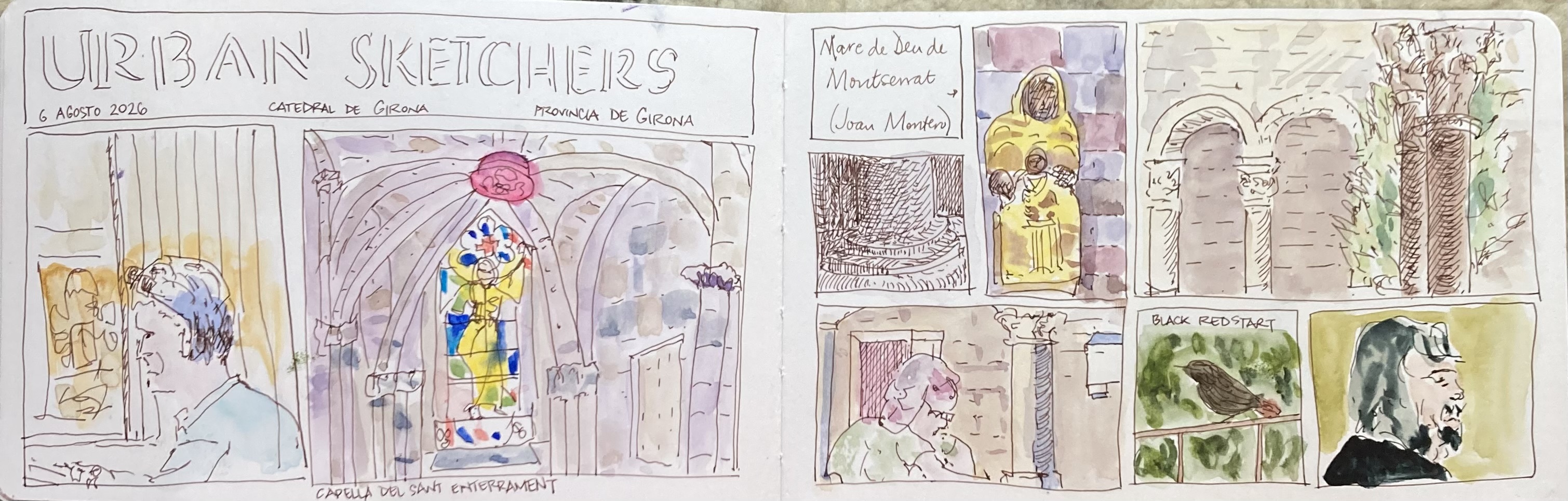
Our trip coincided with the weekly meeting of the Girona Urban Sketchers in the cathedral at the top of the hill. The cathedral’s construction was halted for some time by the arrival of the Black Death, with the result that it ended up being the second widest nave in the world by the time it was finished (after St. Peter’s in Rome). It also never received its second spire. We spent a lovely few hours sketching in and around the cathedral and cloisters.
 Girona has the reputation of being very expensive. It is now a major cycling hub, since many professional cyclists on the grand tour circuit like to train in the mountains; many of the better paid cyclists can afford to live here. A constant refrain throughout our trip was the bemoaning of housing prices that have been driven up by foreigners, many from northern Europe, who earn more than the locals and are having a deleterious effect on prices (and, of course, dilution of the Catalan culture, about which Gironans are especially proud). The Catalan government is very eager to promote Catalan language learning. Another modern office set in a house that was centuries old was a language school, with a request for volunteers to help teach their language.
19 August 26
Football In The Plaza
We arrived in Spain just two weeks after the country had won the World Cup. One of the threads we mused upon during the tournament is why it will be generations before the United States men’s team wins the World Cup. This felt evident during the loss of the United States team to Belgium, where the US simply did not have the ball control skills to beat a mid-tier European side. If they had somehow managed to win that match, they would have next met and surely lost to Spain in the quarterfinals, a team whose ball control skills overshadows everyone else’s. The point is that ball handling skills are picked up early on in children’s play, and the culture in the United States simply doesn’t engender this.
In Tivissa we stayed with friends whom we met in 2024 when the family came to Davis and rented the house two doors down from ours because the mother had a postdoc at the university here. They have three children: the two boys are now 12 and 13, and the girl is now 6. While staying in Davis the boys were active in youth sports, both in soccer through the Davis Legacy soccer club and in little league baseball. The soccer coaches in Davis all wanted the middle-aged boy to play on their team, because he scored lots of goals.
We got to witness the kids playing street soccer in Tivissa; in the evenings they would troop on down unsupervised to the plaza next to the church part of which dated back to the 13th century and kick the ball around, attempting to score goals against the wall of the church, the oldest boy in the family being the goalkeeper. There were 6 to 8 kids in total, ages maybe 10 to 13, including a couple of girls, one of whom was a long jump champion across Catalunya for her age group.
I felt like an anthropologist watching these kids. First, because this sort of unsupervised play is not something one has seen in the United States for a couple of generations, though this is facilitated by the small size of Tivissa — it is a village of 1700 people. (We’ve mentioned watching the television show El Foraster about village life in Catalunya before; Tivissa has in fact featured in an episode of this show.) More germane from the sports culture point of view, there is a direct line from this sort of street play by the kids to the dominance of Spain in global soccer, both men’s and women’s sides. The winner of the best young player award at this year’s World Cup, the center-back Pau Cubarsí, now 19, grew up in a village in Girona province in Catalunya of less than 200 people. Learning to kick a ball around is simply what kids do in Catalunya.